

2040 Official Community Plan
Planning Context

The 2040 OCP is a visionary document that establishes how Kelowna will grow over the next 20 years. The plan directions are the result of background research, demographic analysis, and community engagement undertaken through the planning process. Through this work, several trends were identified that are likely to shift behaviours and influence decisions about housing, employment, and transportation on a day-to-day basis.
Prepared by Aaron Derickson (Indigenous) and Wayne Wilson (Settler)
The City of Kelowna is located in the Okanagan Valley, the traditional unceded territory1 of the syilx (or Okanagan) people. Of the seven communities2 that comprise the syilx nation in Canada, the City of Kelowna neighbours two: Westbank First Nation and Okanagan Indian Band. Although the City and these communities enjoy a stable relationship, in years past, Canada’s federal policies prevented syilx communities from experiencing an equally just history.
- Syilx Pre-contact (Mellennia - 1810)
The Okanagan Valley has been home to the syilx people for more than 12,000 years.3 Time immemorial. According to Syilx Scholar and Knowledge Keeper, Dr. Jeannette Armstrong, the syilx nation “shared eight tribal districts that were very closely interconnected in terms of the different kinds of habitat that they resided in and the unique aspects that provided food and sustenance in those different areas of the syilx territory”4. For example, the syilx oral story of the Four Food Chiefs illustrates key foods the syilx people enjoyed for millennia, two of which are Saskatoon berries and Salmon, perhaps the most visible to Okanagan Residents.
- European Initial Relationship (1811 - 1890)
Direct European contact occurred in 1811 with fur traders,5 but the well-established trade networks that syilx people had with neighbouring Indigenous nations had long brought European goods such as fashioned metal tools6 and horses that had been introduced in the Okanagan region in the first half of the eighteenth century.7 These impacts positively affected syilx people in their trade, and supported their hunting and trapping activities.8 During this time, syilx people had a robust and complex economy that was dependent on the natural resources of syilx territory9 and on their established trade and alliance relationships.
The arrival of settlers in the Okanagan Valley, and the colonial economy that began to emerge beginning in the mid 1800s, played a central role in the development and birth of the City of Kelowna. At this time, both syilx and non-syilx people participated in both the settler economy and the syilx economy as equals.10 Due to the fact that the Okanagan region was not rich in fur-bearing animals, the Hudson’s Bay Company mainly traded with syilx people for horses, potatoes, guiding and packing services.11
In 1860, cattle ranchers and farmers began to take up low-lying land around the Catholic Oblate mission. At the same time, Governor James Douglas met with Interior-Salish leaders and came to an agreement that the Indigenous leaders saw as “tentative” and to be made full through negotiations and compensation - neither of which were ever concluded12 13. What changed this reciprocal and fair relationship was the creation of Federal Indian Act policies that adversely affected syilx communities.14 This removal from traditional context was a powerful tool in opening the area for pioneers and, contrary to popular belief, this was actively resisted by Indigenous chiefs in the Okanagan15. Land was unequally dispersed to settlers, and syilx people were relegated to life on the new reservations. They were not allowed to purchase land off-reserve, nor were they given land in the same accordance as settlers. In 1865, the Okanagan reserves were drastically reduced in size by J.C. Haynes, a local Justice of the Peace, who argued the boundaries were unnecessary for the syilx people.16
- City Inception (1892 - 1945)
In 1892, the townsite of Kelowna was laid out on these unceded syilx lands. With its clear advantage of lake transportation, Kelowna became an economic and cultural hub and the townsite was incorporated in 1905. “Kelowna” is a Nsyilxcen word for a female grizzly - a reference to the previous landowner on which the city was founded, who was called “Kum-a-stoose” or “bear face” by local syilx people.17
The surrounding landscapes began to change dramatically a few years after incorporation. Between 1904 and 1914, thousands of acres of grazing land, hay flats, and grain fields were planted into symmetric rows of irrigated orchard trees and the entire area turned from brown to green. Industry quickly kept pace with the new agricultural economy, and the city’s north end began to fill with packinghouses, box factories, canneries and more, all of these linked by a web of rail spur lines, sidings, and rail-barge slips. The seasonal rhythms and patterns of the tree fruit industry were quickly established. Through the 1920s and 1930s, Kelowna’s economic, social, and cultural life continued to mature.
At the same time, the syilx population experienced increased isolation. They maintained, however, an important part of the regional economy as key and knowledgeable employees in farming, forestry, and other sectors.
- World War II - present (2020)
In the decades since World War II, the pace and direction of change in Kelowna has shifted dramatically. Transportation improvements, such as the W.R. Bennett Bridge, the Okanagan Connector, and Highway 97C have allowed people to move and goods to flow to, from, and within the region more efficiently. Meanwhile, the “Ellison Field” airstrip that opened in 1947 has grown into Kelowna International Airport, Canada’s 11th busiest airport.
The local economy began to shift in significant ways during this time as well. Kelowna’s industrial base began to diversify, its tourism appeal grew in new directions, and the wine industry began to add a new complexity to both agriculture and tourism. More recently, the high-tech sector has strengthened in new links between the city and distant centres.
The city saw new suburban neighbourhoods and shopping centers being developed. More recently, new neighbourhoods have begun to emerge in the hillsides surrounding the city, while efforts to encourage more growth Downtown and in the other urban town centres began to strengthen. Significant investments were made in parks, recreation centres, cultural facilities and other amenities.
During this time period, WFN (then Westbank Indian Band) was developing their land base as a means of securing economic security for their community. They developed a land use plan, bylaws and engaged in leasing portions of t heir land base. In 1974, syilx people from all seven communities took part in the famous “sit-in” of the district Indian Affairs Office, located in Vernon. Syilx communities wanted to govern themselves, independent from the paternal policies of the Indian Act. In 1987, the syilx people signed the Okanagan Nation Declaration, declaring their sovereignty.18
- Kelowna Today (2021) - Looking forward
Kelowna continues to act as a regional hub and is expected to grow by approximately 45,000 citizens over the next 20 years. To accommodate this growth responsibly, planning decisions must consider social, economic and environmental factors. By focusing investment into Urban Centers, supporting a variety of transit options, promoting housing diversity and incorporating equity into City initiatives, Kelowna will be set up for success when it comes to addressing future challenges.
Today, the City of Kelowna actively engages with both syilx communities. There are currently four syilx reserves within city limits, three of which belong to Westbank First Nation, and one of which belongs to Okanagan Indian Band. The City of Kelowna committed to engaging with the syilx/Okanagan people and is actively working to build a relationship based on trust, understanding and mutual benefit, one that is built on a foundation that respects and learns from the past while embracing the environmental, social, economic and cultural realities of today.
Referenced documents (citations)
1. The traditional territory of the Syilx-Okanagan people spans an area that dips down across the U.S. border into Washington state, and spans upwards just passed the Arrow Lakes. The City of Kelowna is situated roughly in the middle of this territory.
2. The Syilx nation crosses the 49th parallel and dips down into the Washington state, U.S.
3. The consensus among scholars is that the Syilx Okanagan people inhabited the Okanagan Valley River Basin for 12,000 years, as a conservative estimate (Sam, 2008; Armstrong, Thompson, Teit & Boaz).
4. Jeanette Armstrong. Interviewed by Lally Grauer, “Reciprocities: Kindness and the Land.” Lake: Journal of Arts and Environment, Faculty of Creative and Critical Studies University of British Columbia Okanagan, 2008.
5. ***
6. ***
7. Fraser, 2007.
8. Thomson, 1994.
9. Turner, Bouchard & Kennedy, 1980
10. OHS, Clement, 1959, p.121
11. Thomson, 1994.
12. The beginning of unceded
13. Thomson, 1994, p.102
14. Thomson, 1994.
15. Armstrong et al. p. 44-66; Thompson, 2007, p. 28-29
16. Thomson, 1994.
17. OHS, Clement, 1959.
18. Okanagan Nation Declaration, 1987
Several major trends have informed the Plan’s pillars, Growth Strategy, objectives and policies.
- Provincial housing legislation. In late 2023, the Province passed a suite of legislation to shift to a more proactive approach to planning and zoning to enable more housing to be built in the right places faster. This legislation required local governments to allow more small-scale multi-unit housing in most neighbourhoods and introduced new Transit Oriented Areas where additional housing density is required. The new framework emphasizes long-term planning to ensure that enough land is designated and pre-zoned to meet both current and future housing needs. To achieve this, municipalities are required to complete a new Housing Needs Assessment every five years. OCPs and Zoning Bylaws are also updated on a five-year cycle to ensure future land use and zoning aligns with the need identified in the Housing Needs Assessment.
- Fast growing and changing population. Kelowna has consistently grown faster than the province and similar sized cities over the past two decades. Between 2016 and 2021, Kelowna's population growth rate accelerated, and the population increased by 13.5 per cent compared to 7.6 per cent in BC. The future growth rate is also anticipated to remain higher than the province but will fluctuate with changing federal immigration policy, shifting inter and intra provincial migration, and economic influences. Kelowna is not only growing quickly, but its demographics are also shifting. Historically known as a retirement destination, current trends show that Kelowna is getting younger. In 2021, for the first time in more than a quarter century, Kelowna's median age was lower than the province's, influenced by people moving to Kelowna from other areas of Canada and other countries.
- Housing affordability. Kelowna residents continue to face significant housing affordability challenges, as the demand to live in Kelowna has outstripped the supply of new homes. High housing costs are making it difficult for many people, especially those with low to moderate incomes, to find suitable and affordable homes leaving them less income available for essential needs that are vital to maintaining overall well-being. In addition, the lack of affordable housing options is also impacting the local economy, as businesses struggle to attract and retain employees who cannot afford to live in the area. Additionally, the financial burden of housing is contributing to homelessness and making it harder for vulnerable groups, such as seniors, lone-parent families, and people with disabilities, to secure stable housing. More recently, a major influx of new homes - particularly rental homes - is helping to close the supply gap. Rents are starting to stabilize or even decline. With many more homes under construction, this trend is likely to continue into the near future; however, ongoing housing construction is needed to keep up with longer term population growth.
- Infrastructure challenges. The City is seeing a greater share of its annual budget being directed to cover maintenance and renewal of aging infrastructure, while also balancing the need to fund infrastructure for new growth. The tension between these objectives has resulted in a significant infrastructure deficit. The most vital step in the path towards financially sustainable service delivery is managing how and where we grow. Recent analysis indicates that the costs to maintain infrastructure in suburban areas are considerably higher than the tax revenue collected in these areas. In response, the Growth Strategy focuses on multi-family and mixed-use development in the Core Area and Urban Centres to reduce long-term infrastructure life-cycle costs and deliver services in a more sustainable way.
- Amenity-rich walkable areas. There is a growing interest in urban places that provide a variety of amenities, such as shops and services, and that are close to jobs and economic opportunities as they support positive physical and mental health outcomes. As younger generations seek amenity-rich neighbourhoods with diverse housing types, increased demand for housing in walkable urban places is anticipated. The 2040 OCP Growth Strategy anticipates that a higher proportion of development will occur in the form of apartments and multi-dwelling ground-oriented homes in Kelowna's amenity-rich Urban Centres and Core Area.
- Equity gap. Across Canada, citizens are experiencing increases in the cost of living, particularly for things like housing, transportation, energy costs and childcare. Additionally, racialized populations and people with disabilities are experiencing an elevated risk of negative health outcomes and homelessness. For this reason, cities are rethinking their approach to infrastructure investment, planning and service delivery in recognition that these actions have a disproportionate impact on the quality of life and economic future of the most vulnerable. By infusing equity into the 2040 OCP, the City will be better positioned to ensure all citizens are able to benefit from the City's growth - through improved health outcomes, access to opportunities and more affordable housing options.
- Low carbon resilient future. Communities across Canada are recognizing the threat that climate change poses to community infrastructure, the environment, biodiversity, the economy and human health. Our region is increasingly experiencing the impacts of climate change through extreme weather events such as flooding, drought and wildfires, which are already occurring more frequently. To prevent rapid and extreme climate change, significant reductions in greenhouse gas emissions and a shift to a low-carbon community are required. At the same time, Kelowna must also be prepared for the impacts of a changing global climate. To meet climate goals, the 2040 OCP promotes complete communities that can support a major decrease in transportation emissions while investing in transit and active transportation. Additionally, the 2040 OCP identifies approaches to enhance green infrastructure and wildfire mitigation, acknowledging that the incidence of extreme weather events is increasing.
- Population Projections
From 2021-2041, the City's growth rate will fluctuate depending on levels of economic growth, demographic trends, as well as national and international migration patterns. The projections provided in this chapter guide the land use plan and policies of the 2040 OCP, as well as servicing plans and financial strategies.
BC Statistics projects Kelowna's population will grow at an average annual rate between 1.4 and 2.2 per cent over the next two decades. This will result in the population growing by nearly 50,000 people in a lower growth scenario and up to 85,000 additional citizens in a higher growth scenario. Overall, Kelowna's population is projected to be between 196,000 and 233,000 by 2041 as illustrated in Table 2.1. The various iterations of projections from BC Statistics results in a significant range in population; however, further third-party analysis indicates that Kelowna's population will likely be in the middle of the range, with an average annual growth rate of 1.6 per cent resulting in a population of approximately 207,000 in 2041.
| Time Period | Average annual growth rate | Population growth | Population at end of period |
|---|---|---|---|
| 2021 - 2025 | 2.2 - 3.0% | 17,393 - 23,658 | 165,216 - 171,481 |
| 2026 - 2030 | 0.9 - 2.4% | 7,534 - 21,454 | 172,570 - 192,935 |
| 2031 - 2035 | 1.4 - 2.0% | 11,960 - 20,158 | 184,530 - 213,093 |
| 2036 - 2041 | 1.0 - 1.5% | 11,620 - 19,493 | 196,150 - 232,586 |
- Projected Age Distribution
Over the next 20 years Kelowna's population will grow significantly across all age groups. Generally, the demographic composition of the population is expected to be similar between 2020 and 2041. However, Kelowna is projected to see an increase in the proportion of people aged 25 to 64 and a decrease in the proportion of people under the age of 25. This reflects low levels of natural increase and Kelowna's reliance on national migration for population growth. Table 2.2 provides more detailed information.
| Year/Age | Under 25 | 25 - 44 | 45 - 64 | 65+ |
|---|---|---|---|---|
| 2020 | 26% | 28% | 25% | 21% |
| 2030 | 24% | 32% | 22% | 22% |
| 2041 | 22% | 31% | 26% | 21% |
- Housing Projections
The Province mandates municipalities to complete a Housing Needs Assessment (HNA) every five years using a standardized methodology. These assessments help local governments better understand current and future housing needs. They identify existing and projected gaps in housing supply by collecting and analyzing quantitative and qualitative information about local demographics, household incomes, housing stock, population projections, and other factors to determine the number of housing units needed to accommodate anticipated growth as well as existing unmet need.
As required by the Province, the 2040 OCP is informed by Kelowna's Interim Housing Needs Assessment, completed in 2024. This assessment, based on the higher BC Stats growth projections, estimated that Kelowna needs 45,000 new residential units between 2021 and 2041. Over 39,000 of these units are to accommodate new growth, while the remaining newly 6,000 units are to address existing unmet needs in the community.
Housing affordability, trends towards smaller households, shifting housing preferences, changing demographics and shifting transportation behavior will influence where these new residential units will go and what form they will take. Collectively, these and other trends are expected to boost demand for multi-dwelling housing units in the Urban Centres and Core Area as Kelowna continues its evolution as an emerging mid-sized city over the next 20 years. This is already being seen in the local housing market. Between 2021 and 2024, 68 per cent of the building permits issued were for apartment dwellings, highlighting the significant shift toward more compact housing forms. Kelowna also saw record levels of rental housing construction during that period, with over 2,900 rental units completed.
- 20-Year Average Household Size
2.15 people per new household = (84,763 people / 37,118 new units)
The 20-year average household size is derived using the projections for new housing units to accommodate population growth expected over the next 20 years. It does not include the new units needed to address current unmet housing needs in the community.
- Housing type
Currently, the majority of homes (68 per cent) are in the form of ground-oriented housing, and 32 per cent are in the form of apartment housing. Based on the shift to a more urban Growth Strategy, the 2040 OCP anticipates the demand for apartment housing will continue to increase over the next 20 years. To encourage housing that meets this demand, the 2040 OCP is projecting that 65 per cent of new units (29,400 homes) over the next 20 years will be in the form of apartment housing and 35 per cent (15,600 homes) will be in the form of ground-oriented housing. Table 2.4 provides an estimate of housing unit projections over the next 20 years; however, it is expected that the number of building permits issued will fluctuate based on local real estate and land development cycles.
| Year | Ground-oriented units | Apartment units | Total ground-oriented and apartment units |
|---|---|---|---|
| 2021 - 2025 | 4,806 | 9,057 | 13,863 |
| 2026 - 2030 | 4,085 | 7,699 | 11,784 |
| 2031 - 2041 | 6,709 | 12,644 | 19,353 |
| Total 2041 | 15,600 | 29,400 | 45,000 |
- 20-year Housing Distribution
Based on Future Land Use and current zoning, Kelowna has capacity for over 250,000 additional residential units. This simplified approach estimates the maximum potential zoned capacity minus existing residential units. The approach does not account for things like property constraints, age of existing buildings or development potential, all of which could reduce capacity, but it does demonstrate that there is significant capacity in the community to accommodate well beyond the 45,000 units identified in the Housing Needs Assessment.
The 20-year housing distribution takes these factors into consideration and models the potential of where new housing units are likely to occur. Over the next 20 years, most of the 45,000 new housing units anticipated are expected to be accommodated in urban areas like Urban Centres and the Core Area, which will preserve rural lands outside the Permanent Growth Boundary, allow for cost-effective servicing, reduce car dependency and decrease GHG emissions. Growth in urban areas will mainly take the form of redevelopment as parcels are assembled and redeveloped into townhouses, apartments and towers.
Over the period, 71 per cent of the Kelowna's future growth will occur in the City's five Urban Centres and the surrounding Core Area. Specifically, the growth scenario projects that 38 per cent of new units will be accommodated within the Urban Centres and 33 per cent of the units will be accommodated within the Core Area. The Gateway, Suburban Neighbourhoods and Rural Lands growth strategy districts are expected to accommodate the remaining 29 per cent of new units to 2041. The growth scenario does not introduce any new suburban neighbourhoods beyond what has already been approved.
Overall, the 20-year Servicing Plan and Financing Strategy are guided by the number and distribution of projected housing units to 2041 shown below and on Map 2.1. The housing distribution targets provided below also guide long-term infrastructure servicing requirements as well as key projects for the City's Transportation Master Plan. These targets have also informed the future land use designations and policies to ensure alignment between planning policy and the City's growth management strategy. The unit targets, provided in Table 2.5, will need to be monitored to inform prioritization of key capital projects as some areas will achieve their growth prior to 2041, while others will see a slower rate of growth.
| Growth Node | New Units 2041 (Approximate) |
|---|---|
| URBAN CENTRES | 17,105 (38%) |
| Capri Landmark Urban Centre | 2,160 |
| Downtown Urban Centre | 6,939 |
| Pandosy Urban Centre | 1,969 |
| Midtown Urban Centre | 3,154 |
| Rutland Urban Centre | 2,883 |
| CORE AREA | 14,844 (33%) |
| Core Central | 3,141 |
| Core Glenmore | 2,988 |
| Core Hospital | 2,131 |
| Core Lakeshore | 2,463 |
| Core Midtown | 18 |
| Core Rutland | 2,259 |
| North End | 1,844 |
| SUBURBAN | 9,626 (21%) |
| Black Mountain | 869 |
| Clifton | 209 |
| Dilworth | 2,453 |
| Kirschner Mountain | 1,197 |
| Lower Mission | 291 |
| McKinley Beach | 960 |
| The Ponds | 725 |
| Tower Ranch | 592 |
| Upper Mission | 699 |
| Wilden | 1,631 |
| GATEWAY | 1,288 (3%) |
| Beaver Lake Industrial | 0 |
| Gateway Industrial | 14 |
| University | 1,274 |
| REST (Suburban / Rural) | 304 (1%) |
| North Kelowna Rural and Suburban | 207 |
| South Kelowna Rural and Suburban | 97 |
| SECONDARY SUITES* | 1,833 (4%) |
| TOTAL | 45,000 |
*Secondary suites are anticipated in all growth strategy districts.
Based on the expected population growth in the City and surrounding region, Kelowna is expected to see a significant increase in commercial development over the next 20 years. The 2040 OCP provides projections to inform the long-term demand for retail, office and industrial development.
The City of Kelowna is the regional retail centre for the Central Okanagan, serving the broader region from Penticton to Vernon as well as the growing local population in Kelowna. The 2040 OCP estimates approximately 193,000 square metres of new retail space will be supportable in Kelowna by 2040, representing an increase of 32 per cent from the retail inventory in 2020. The 2040 OCP retail projection includes the following types of retail uses: convenience, comparison, service, food and beverage, entertainment and automotive.
The following trends were considered when preparing the City’s 2040 retail projections:
- E-commerce. The growth in online shopping is anticipated to reduce long-term demand for retail space compared to historical averages. Further, the COVID-19 pandemic is expected to accelerate the shift in consumer behaviour away from traditional brick and mortar comparison retail to e-commerce.
- Experiential Retail. Future growth in retail will be driven by a desire for unique experiences, with comparison retail, convenience retail, restaurants, cafes and other entertainment predominantly occurring in Urban Centres. The growth of experiential retail is expected to occur through mixed-use residential projects in ground floor commercial space, which will animate retail streets and serve the growing population of urban dwellers in Kelowna.
- Covid-19 Impacts. Due to the recession caused by the COVID-19 pandemic, the 2040 OCP anticipates that there will be a decrease in demand for several types of retail space in the near- term. An increase in unemployment, lower levels of discretionary income and social distancing measures will result in greater rates of closures and bankruptcies and present a challenging climate to start new retail businesses. The 2040 OCP anticipates reduced demand for specific sectors (e.g. food and beverage) in the near-term with greater development activity expected from 2031-2040. However, the 2040 OCP also assumes that the recovery of the comparison retail sector will be challenged as COVID-19 accelerates the shift to online shopping and decreases the demand for this type of space in Kelowna moving forward.
| Time Period | 2021-2025 | 2026-2030 | 2031-2035 | 2036-2040 | Total |
|---|---|---|---|---|---|
Commercial Retail Space Demand (sq. m.) | 41,740 | 49,780 | 52,480 | 49,100 | 193,100* |
*New retail floor area will require limited new land as most new retail space will be accommodated in the podiums of larger mixed-use residential developments.
Over the next twenty years the City’s inventory of office space is likely to see a major increase. Kelowna is the primary employment centre for the Central Okanagan and is home to almost all Class A office space in the region with office towers concentrated throughout the Core Area. Over the next 20 years the 2040 OCP projects an annual net absorption rate of 5,500 to 7,500 square metres of office with a total of 119,450 square metres to be developed by 2040.
Demand for Class A office space will continue to be strongest within centrally located and amenity-rich Urban Centres (i.e. Downtown, Pandosy and Capri-Landmark). As tenants shift to newer and more modern Class A office space, there is likely to be higher vacancies in Class B office space in older and less desirable locations, encouraging redevelopment to realize value from declining properties. Demand for office space is expected to increase from 2030-2040 after major Class A projects are absorbed by the local market, translating into higher rates of office development from 2030-2040.
There are several national and regional trends that are expected to impact demand for commercial development over the next 20 years.
- Major Office Projects. In 2019-2020, construction began on a 28,000 square metre Class A office project in the Landmark District which is expected to reduce demand for Class A office space for the first 5-10 years of the 2040 OCP.
- Technology Acceleration. Growth in the Okanagan’s technology sector continues to ensure a stable demand for office space, especially for smaller Class B office inventory in central locations.
- Coworking Growth. Coworking is already part of the local sharing economy of Kelowna with approximately 6,000 square metres in operation. Coworking also allows smaller firms to avoid signing expensive leases, reducing overhead costs and offering the potential for collaboration and mentorship within the coworking community. The growth of coworking could result in less demand for conventional brick and mortar office space within certain sectors, and overall reduce demand for smaller office projects.
| Time Period | 2021-2025 | 2026-2030 | 2031-2035 | 2036-2040 | Total |
|---|---|---|---|---|---|
Commercial Retail Space Demand (sq. m.) | 20,250 | 27,700 | 34,700 | 36,800 | 119,450 |
The total amount of new office space development projected by the 2040 OCP is an increase of approximately 30% between 2021 and 2040.
The 2040 OCP projects a significant increase in industrial development over the next twenty years. Over this time, it is expected that Kelowna’s manufacturing sector will continue to decrease, but growing demand for storage, distribution, warehousing, cannabis and other uses will drive demand for industrial space. The shift away from manufacturing and heavy industrial activity reflects Kelowna’s ongoing transformation to a regional service centre and the growth of knowledge-based employment.
Over the last several years Kelowna has seen a severe shortage of affordable, serviced industrial space as a result of speculation on industrial land for more valuable commercial uses, such as hotels and retail. From 2017-2019, the City has witnessed extremely low industrial vacancy rates (1-3 per cent), highlighting the strong demand for industrial space. By 2040 the OCP projects roughly 323,000 square metres of new industrial space with the greatest demand from 2031-2040.
Industrial development will be challenged by the lack of land available for low-density industrial projects and the inability for industrial uses to be incorporated into mixed-use projects. Overall, the 2040 OCP projects the need for approximately 95 hectares of land to meet the demand for industrial businesses as well as retail businesses using industrial space over the next 20 years. This projection is based upon the assumption that recent densities (floor area ratio of approximately o.25) of industrial development will be achieved. However, if land becomes particularly constrained it is possible densities could rise closer to a floor area ratio of 0.35.
| Time Period | 2021-2025 | 2026-2030 | 2031-2035 | 2036-2040 | Total |
|---|---|---|---|---|---|
Industrial Floor Space (sq. m.) | 67,000 | 57,400 | 95,000 | 104,300 | 323,700 |
| Total Land Required (hectares) | 19.5 | 16.6 | 28.2 | 31 | 95.3 |
Over the last 10 years, Kelowna has seen an annual average of 12,000 square metres of institutional development. Institutional development in Kelowna largely occurs through government funded infrastructure programs related to hospitals, care facilities, schools and college and university expansions. This type of development is heavily reliant on regional population growth and availability of senior government funding and infrastructure programs. As a result, this form of development is less influenced by the development market and private sector, but instead more driven by major civic or provincial projects (e.g. educational or health facilities). The 2040 OCP anticipates most of the new institutional development will occur on underutilized lands designated institutional or park as well as in the Hospital District. Although a 20-year target is not established, the 2040 OCP has provided for the future expansion of critical institutions such as schools, hospitals, and other civic facilities.
In accordance with Section 446 of the Local Government Act, an OCP must include a Regional Context Statement where a Regional Growth Strategy (RGS) applies to the same area as the OCP. Kelowna is within the jurisdictional boundary of the Regional District of Central Okanagan (see Map 2.2). The Regional District of Central Okanagan Regional Growth Strategy Bylaw No. 1336, 2013 was adopted on June 23, 2014.
The RGS establishes a vision for the region to grow in a manner that promotes economic, environmental and social health. The policy direction of the City of Kelowna OCP is consistent with the intent of the RGS. Table 2.9 below demonstrates the connection between the RGS issue areas and goals and relevant OCP objectives and policies.
Table 2.9: Relationship between Regional Issue Areas and the OCP
| Regional Growth Strategy Issue Area & Goal | Related OCP Section | |
|---|---|---|
| Pillars | Key Objective | |
| Our Land To manage the land base effectively to protect natural resources and limit urban sprawl |
| Objective 4.1. Strengthen the Urban Centres as Kelowna’s primary hubs of activity. Objectives 4.3 and 5.5. Protect and increase greenery in Urban Centres and the Core Area. Objective 5.1. Encourage Village Centres as Kelowna’s secondary hubs of activity. Objective 5.2. Focus residential density along Transit Supportive Corridors to improve Core Area Neighbourhood livability. Objective 7.2. Design Suburban Neighbourhoods to be low impact, context sensitive and adaptable. Objective 8.4. Stop urban sprawl into Rural Lands. Objective 13.1. Prioritize infrastructure investment targeting high growth areas. |
| Our Economy To develop and enhance a positive business environment in the region to achieve a dynamic, resilient and sustainable economy | 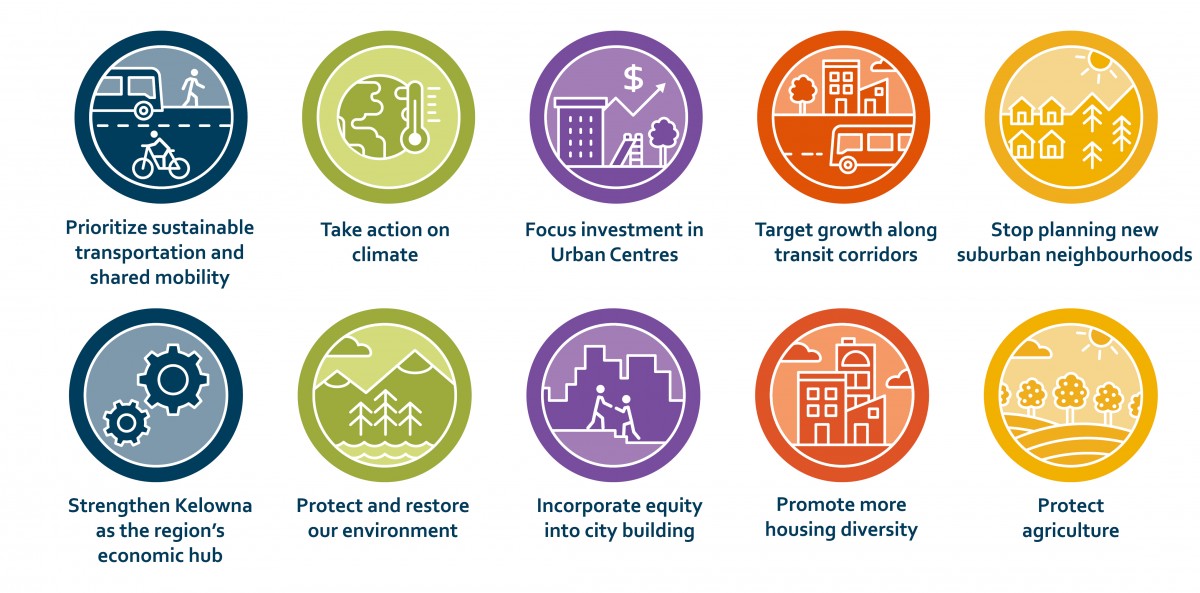 | Objective 4.1. Strengthen the Urban Centres as Kelowna’s primary hubs of activity. Objective 5.6. Focus large format commercial along the Highway 97 corridor. Objective 5.8. Encourage employment‐intensive industrial uses in the Core Area. Objective 6.1. Support the evolution of the University of British Columbia – Okanagan into a more complete community. Objective 6.3. Support the strategic and planned growth of Kelowna International Airport as a regional economic generator. Objective 6.4. Support the continued development of industrial lands. Objectives 6.7 and 8.1. Protect and preserve agricultural land and its capacity. |
| Our Water Resources To manage and protect water resources | | Objective 12.10. Adapt to a changing water supply. Objective 13.3. Design stormwater infrastructure to mitigate flooding and pollution to our neighbourhoods, streams and Okanagan Lake. Objective 13.4. Provide a secure supply of water. Objective 13.5. Protect the supply of high‐quality drinking water. Objective 14.3. Preserve Okanagan Lake for its environmental, traditional, cultural, spiritual, and recreational values. |
| Our Health To contribute to the improvement of community health, safety, and social wellbeing | | Objective 4.2. Foster more inclusive and socially connected Urban Centres. Objective 5.4. Strategically locate community services to foster greater inclusion and social connections in the Core Area. Objective 5.7. Support the strategic and planned growth of the Kelowna General Hospital campus as the region’s most critical health facility. Objective 9.1. Incorporate equity into planning decisions and resource allocation in our community. Objective 9.2. Strengthen the relationship with the syilx/Okanagan people through initiatives and processes to advance and support reconciliation in Kelowna. Objective 9.3. Develop diverse partnerships to advance complex social planning issues and increase community wellbeing. Objective 10.1. Acquire new parks to enhance livability throughout the city. Objective 14.1. Promote strategies that reduce local air pollution and people’s exposure to air pollutants. |
| Our Food To support a regional food system that is healthy, resilient and sustainable | | Objectives 4.10., 5.9., 6.5. and 7.5. Strengthen the local food system to increase food security, equitable access to healthy food and social connections. Objectives 4.11., 5.10., 6.8., 7.4. and 8.2. Ensure a compatible urban‐rural interface that protects agricultural uses. Objectives 6.7. and 8.1. Protect and preserve agricultural land and its capacity. Objective 6.15. Maintain safe roads that support agricultural uses. Objective 8.3. Strengthen the local food system to increase food security and social connections. Objective 8.4. Stop urban sprawl into Rural Lands. |
| Our Housing To improve the range of housing opportunities to meet the social and economic needs of the region | | Objective 4.1. Strengthen the Urban Centres as Kelowna’s primary hubs of activity. Objectives 4.12. and 5.11. Increase the diversity of housing types and tenures to create inclusive, affordable and complete Urban Centres and Core Area. Objectives 4.13. and 5.12. Protect citizens from displacement due to Urban Centre and Urban Core development. Objectives 4.14. and 5.13. Protect the rental housing stock. Objective 5.2. Focus residential density along Transit Supportive Corridors to improve Core Area Neighbourhood livability. Objective 5.3. Design residential infill to be sensitive to neighbourhood context. Objective 6.10. and 7.7. Prioritize the construction of purpose‐built rental housing. Objective 7.6. Support a variety of low‐density housing. |
| Our Climate To minimize regional greenhouse gas emissions and respond to the impacts of climate change | | Objective 4.1. Strengthen the Urban Centres as Kelowna’s primary hubs of activity. Objective 8.4. Stop urban sprawl into Rural Lands. Objective 12.1. Design the community to reduce greenhouse gas (GHG) emissions. Objective 12.2. Prioritize climate change mitigation and adaptation in City operations. Objective 12.3. Encourage the community to take action to mitigate and adapt to climate change. Objective 12.4. Improve energy efficiency and reduce greenhouse gas emissions of new buildings Objective 12.5. Improve energy efficiency and reduce operational greenhouse gas emissions of existing buildings. Objective 12.6. Transition toward 100 per cent renewable energy by 2050. Objective 12.7. Support the transition to emerging low‐ emission transportation technologies. Objective 12.8. Invest in ecosystem services and green infrastructure to mitigate and adapt to a changing climate. Objective 12.9. Support the community to prepare for and become resilient to the impacts of climate change. Objective 12.11. Increase resilience to extreme weather events. |
| Our Ecosystems Be responsible stewards of natural ecosystems to protect, enhance and restore biodiversity in the region | | Objective 12.12. Reduce risk to public health, the local economy and the environment related to invasive species. Objective 14.2. Protect and expand a healthy and viable urban forest. Objective 14.4. Preserve and enhance biodiversity and landscape diversity, integrating and connecting ecological networks through the city. Objective 14.5. Protect and restore environmentally sensitive areas from development impacts. Objective 14.6. Provide compensation for unavoidable habitat losses. |
Our Transportation | | Objective 4.15. Make Urban Centres safe and enjoyable for walking, biking, transit and shared mobility. Objective 4.16. Develop a well‐connected grid network of streets to shorten walking distances and improve traffic circulation. Objectives 4.20., 5.20. and 6.17. Adapt and respond to emerging transportation technologies. Objective 5.2. Focus residential density along Transit Supportive Corridors to improve Core Area Neighbourhood livability. Objective 5.15. Create major streets that are walkable, support local retail and connect neighbourhoods to Urban Centres by car, bike and transit. Objectives 5.17., 6.14. and 13.8. Protect and enhance the Okanagan Rail Trail as a vital transportation corridor linking communities in the Okanagan Valley. Objective 6.12. Develop a well‐connected supporting street network to facilitate travel by alternate modes and reduce reliance on Highway 97. Objective 7.8. Reduce dependence on the automobile where possible. |
| Our Governance To respond to the needs of the region with an effective and efficient governance service model | | Objective 16.3. Strategically deliver on implementation actions. |