

2040 Official Community Plan
Heritage Conservation Area

Certified Arborist
A person accredited as such by the International Society of Arboriculture.
Character Defining Elements
The materials, forms, location, spatial configurations, uses and cultural associations or meanings that contribute to the heritage value of an historic place, which must be retained in order to preserve its heritage value.
Contributory Properties
Properties, including contributory houses, that contribute to the character of the HCA - Conservation and Development Guidelines due to their historic development era, form and siting and/or have been determined to have heritage value (Map 23.2).
Heritage Alteration Permit
A permit under section 617 of the Local Government Act.
Heritage Character
The overall effect produced by traits or features which give a property or an area a distinctive heritage quality or appearance, as noted in the Statement of Significance.
Heritage Conservation Area
An area designated by the City of Kelowna 2040 Official Community Plan (as amended or replaced from time to time) as a Heritage Conservation Area pursuant to the Local Government Act. An HCA is a recognized method to identify, acknowledge, record, and protect local heritage that has a particular value to the community. Individual properties within an HCA may exhibit heritage value, but it is the overall heritage character and value that distinguishes a Heritage Conservation Area.
Heritage Conservation Covenant
A Heritage Conservation Covenant allows a local government to negotiate terms of a contractual agreement with a property owner to legally protect a heritage asset from demolition or alteration. The covenant is registered on Title in perpetuity.
A Heritage Designation Bylaw
A Heritage Designation Bylaw is a form of local government land use regulation that protects properties with heritage value or character. This bylaw can safeguard various aspects of a property, including exteriors, structural elements, interior features, and landscape elements, by prohibiting unauthorized alterations, demolitions, relocations, or land changes. A Heritage Alteration Permit is required for any modifications.
Heritage Register
A Heritage Register is an official listing of properties within the community that are identified as having heritage value. Kelowna’s Heritage Register was adopted by Council resolution on March 20, 2000, and is amended periodically.
Heritage Revitalization Agreement
A Heritage Revitalization Agreement, or HRA for short, is a formal, voluntary, written agreement that is negotiated between a property owner and a local government. It outlines the duties and obligations of, and the benefits to both parties of the agreement. The agreement allows local governments to supersede local zoning regulations and to provide non-financial incentives which would make it viable for owners to conserve property of heritage merit.
Heritage Value
The aesthetic, historic, scientific, cultural, social or spiritual importance or significance for past, present or future generations. The heritage value of an historic place is embodied in its character defining materials, forms, location, spatial configurations, uses and cultural associations or meanings.
Historic Place
A structure, property, group of properties, district, landscape, archaeological site, or other place in Canada that has been officially recognized for its heritage value by the relevant jurisdiction.
Maintenance
Routine, cyclical, non-destructive actions necessary to slow the deterioration of an historic place. It entails periodic inspection; routine, cyclical, non-destructive cleaning; minor repair and refinishing operations; replacement of damaged or deteriorated materials that are impractical to save.
Minimal Intervention
The approach that allows functional goals to be met with the least physical intervention.
Snout House
A house with a protruding garage that takes up most of the street frontage.
Statement of Desired Future Character
A roadmap for managing change in a way that respects and enhances the unique historical and cultural significance of the heritage area.
Statement of Significance (SOS)
A statement that identifies the description, heritage value, and character defining elements of an historic place. A Statement of Significance is required in order for an historic place to be listed on the Canadian Register of Historic Places.
Sustainability
A group of objectives (social, environmental & economic) that must be coordinated and addressed to ensure the long-term viability of communities and the planet.
Acknowledging the syilx/Okanagan people, whose rich history and cultural significance are deeply embedded in the lands encompassing the Abbott Street and Marshall Street Heritage Conservation Areas (HCA), is essential. Recognized for their heritage value since 1983 and officially established as Heritage Conservation Areas in 1998, these areas contain evidence of past human activity dating back to times before European settlement.
The vision for these historic areas celebrates the elements valued by the Kelowna community: historic homes, mature landscaping, scenic character, a strong sense of community, and a unique sense of time and place. As neighbourhoods that have continuously evolved and densified since their initial settlement, growth will continue through gentle and thoughtful renovations, house conversions, additions, and new properties. Retaining the authentic, historic character of these areas, combined with a careful and customized approach to development, ensures that residents and visitors alike will continue to experience a unique and valued sense of place well into the future.
 |
A Heritage Alteration Permit will not be required for:
- Interior alterations.
- Exterior maintenance and repairs that do not affect the heritage character of the area or heritage value of the property, including repainting in identical colours or routine upkeep.
- Exterior alterations that are not visible from a fronting street.
- Construction or alteration of decks not visible from a fronting street and not the property’s heritage character.
- Regular or emergency City maintenance of municipal infrastructure.
- Construction that does not require a building permit (landscaping, fencing, small sheds, etc.).
Any work for which a Heritage Alteration Permit is required must conform with:
- All applicable bylaws;
- The “Standards and Guidelines for the Conservation of Historic Places in Canada”, published by Parks Canada in 2003 and updated in 2010;
- The Abbott Street and Marshall Street HCA - Conservation and Development Guidelines; and
- Review from a Heritage Professional Consultant.
 |
In the event of a conflict between the Parks Canada “Standards and Guidelines for the Conservation of Historic Places in Canada” and the Abbott Street and Marshall Street HCA - Conservation and Development Guidelines, the Abbott Street and Marshall Street HCA - Conservation and Development Guidelines will be applied.
Section 614 of the Local Government Act allows local governments to, for the purposes of heritage conservation, designate Heritage Conservation Areas.
Section 615 of the Local Government Act establishes that if an official community plan designates a Heritage Conservation Area, individuals are prohibited from certain actions unless they possess a Heritage Alteration Permit authorizing the action.
Unless exempted, a Heritage Alteration Permit (HAP) addressing conservation and development guidelines (see Conservation and Development Guidelines section) must be approved prior to undertaking any of the following activities within the Abbott Street and Marshall Street Heritage Conservation Areas, as shown on Map 23.1:
- Construction of, addition to, or external alteration of a property or structure.
- Demolition of a property or structure.
The Abbott Street and Marshall Street HCA - Conservation and Development Guidelines are essential for guiding development and change while preserving the heritage values of the neighbourhoods depicted on Map 23.1. These guidelines provide a framework for property owners and developers to make informed decisions that maintain the areas’ aesthetic and historical continuity. By adhering to these guidelines, new constructions and renovations can integrate with the existing built environment, ensuring that the distinctive qualities of these heritage conservation areas are preserved for future generations.
The following objectives collectively aim to balance development and preservation, ensuring that change and density are managed in general accordance with the Key Guidelines in the HCAs and are guided by the areas’ unique character and historical significance.
1. Preservation of Historic Places
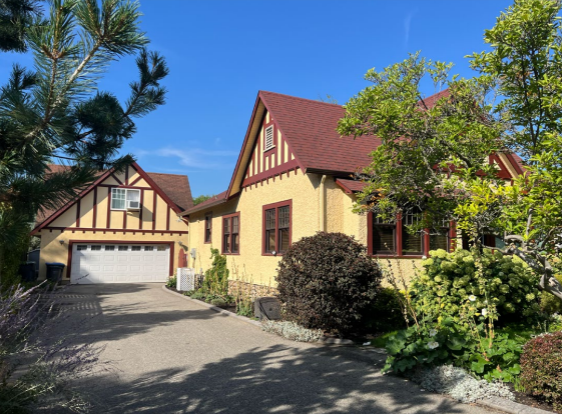
Incentivize and prioritize the retention, maintenance and protection of streetscapes, landscapes, properties, properties and other contributory features, including character and sense-of-place, that are valued in the area, as per the HCAs’ Statement of Significance and Statement of Desired Future Character.
 |
2. Contextual Design and Scale
New development will consider the immediate historic context and align with the Desired Future Character of the Heritage Conservation Areas. Adhere to the Standards and Guidelines for the Conservation of Historic Places in Canada (Standard 11 and Standard 12), ensuring that new constructions are compatible with, distinguishable from, and subordinate to existing historic structures.
 |
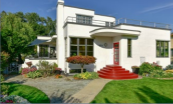
3. Compatible Adaptation and Use
Incentivize and prioritize the adaptive reuse of Contributory houses while conserving their character.
 |
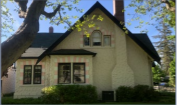
4. Preservation of Neighbourhood Heritage
Preserve the historical context, landscape, and streetscape character of the neighbourhood as an historical, scenic, recreational, and cultural resource in Kelowna.
 |
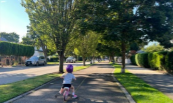
5. Environmental Sustainability
Model and promote the conservation of existing properties, infrastructure and landscapes as a crucial strategy to achieving a sustainable community and combating climate change.
 |
The HCA - Conservation and Development Guidelines are a resource for designers, architects, developers, builders, and property owners planning new properties, additions and alterations in the Abbott Street and Marshall Street Heritage Conservation Areas (Map 23.1). They also serve as an evaluation tool for City staff and municipal decision-makers reviewing proposals. The guidelines clarify how to meet the broad objectives for the Heritage Conservation Area as described in the OCP.
Before starting any design work, individuals involved should refer to the guidelines and consider the following questions:
- How closely does the design adhere to the vision and objectives of the guidelines?
- Where does it depart from them and why?
- Is the design informed by an understanding of the heritage value of the property in question?
- Does the design respond to the Statement of Significance and Character Defining Elements for the area?
- Does the proposal adhere to the Standards and Guidelines for Conservation of Historic Places in Canada (Standard 11), ensuring that new properties and additions are compatible with, distinguishable from, and subordinate to existing historic structures.
For proposals that retain the heritage value in existing contributory houses, variances to conservation and development guidelines and development regulations may be considered, see section Chapter 11: Heritage, of Kelowna's OCP.
The HCA - Conservation and Development Guidelines provide a comprehensive set of criteria aimed at ensuring that proposed changes in the HCAs meet the objectives of these guidelines and adhere to them. These guidelines encompass detailed design intentions, criteria, and rationales to guide, evaluate, and support decision-making regarding the overall form and character of new constructions and additions.
Projects may also be subject to additional guidelines or regulations based on zoning, proposed uses, location, property type, project scale and off-site requirements. Applicants must clearly demonstrate compliance with all relevant guidelines and bylaws. However, it is recognized that the ability to fully meet each guideline may be influenced by factors such as land use, lot size, topography, existing mature vegetation, and the complexity of the project. City staff have the ability to use discretion when evaluating proposals to ensure a balanced approach that meets both the guidelines and the unique circumstances of each project.
Heritage Conservation Areas are collections of heritage resources that together form a greater whole. An HCA itself is a heritage resource, composed of individual elements that collectively create a distinct sense of time and place. Properties that contribute to the heritage value of the area are known as "contributing" properties. Identifying these properties illustrates how the area's heritage value is expressed and guides conservation decisions.
The HCA - Conservation and Development Guidelines are designed to prioritize the retention of contributory properties. To incentivize this preservation, the guidelines allow for adjustments to development regulations when the features of a contributory property are retained. These adjustments may include for example modifications to setback requirements, parking standards, use flexibility, and density increases. Each development proposal is evaluated on a site-by-site basis, with the Development Planning Department exercising discretion in making these decisions. This approach encourages the conservation of the character and historical value of the neighbourhood and its contributory features while accommodating new development needs.
The HCAs also include properties and properties that are not considered contributory to the heritage value of the area, however, changes to non-contributing properties can still impact the area's heritage value and offer opportunities to enhance its character through thoughtful design. Therefore, the HCA - Conservation and Development Guidelines provides guidelines for all properties, with additional considerations for the "contributing" properties.
Methodology
A multi-step process was used to classify properties in the Abbott Street and Marshall Street HCAs as "contributory". Based on the statements of "significance" and 'future character", each property and landscape element were assigned one of these statuses. This classification, along with the guidelines, directs incentives, energy, and sensitivity towards conservation. It allows for development, density, and change while discouraging demolition or significant transformation of character. If essential character defining elements of a contributory property, such as the property, the trees or even the siting, undergoes significant transformation or demolition, it shall no longer retain its classification as a contributory property, and in this, lose its access to potential incentives and development variances.
The Contributory Properties Schedule was created based on the criteria below:
- Listed on the 1983 Heritage Resources Inventory or the Heritage Register (including properties protected by a Heritage Designation Bylaw or a Heritage Revitalization Agreement).
- Identified as having heritage significance - aesthetic, historic, scientific, cultural, social, spiritual or contextual, sometimes with a plaque out front.
- Constructed during the most prolific decades of development, beginning in the 1900s and ending in 1959, which gave the neighbourhood its valued character, as noted in the Statement of Significance.
- Exhibit character-contributing built form with elements such as 1-2.5 storey height with traditional roof forms (gable, hip, gambrel, flat etc.) prominent or end-wall chimneys, bay and picture windows, wood and/or stucco cladding, traditional porches, entries and doors, and rich, contrasting paint schemes.
- Exhibit character-contributing siting and landscaping such as lining up approximately with the neighbouring houses siting, yard featuring mature or traditional landscaping, curved pathways, openly visible from the street.
In contrast, all other properties can be redeveloped in a transformative manner, allowing for new designs that are compatible with, distinguishable from, and subordinate to their neighbouring properties. See Map 23.2: Contributory Properties in the Abbott Street and Marshall Street Heritage Conservation Areas.
Requests to be added or removed from the Contributory Properties Schedule can be submitted to the City to be reviewed by a heritage registered professional.
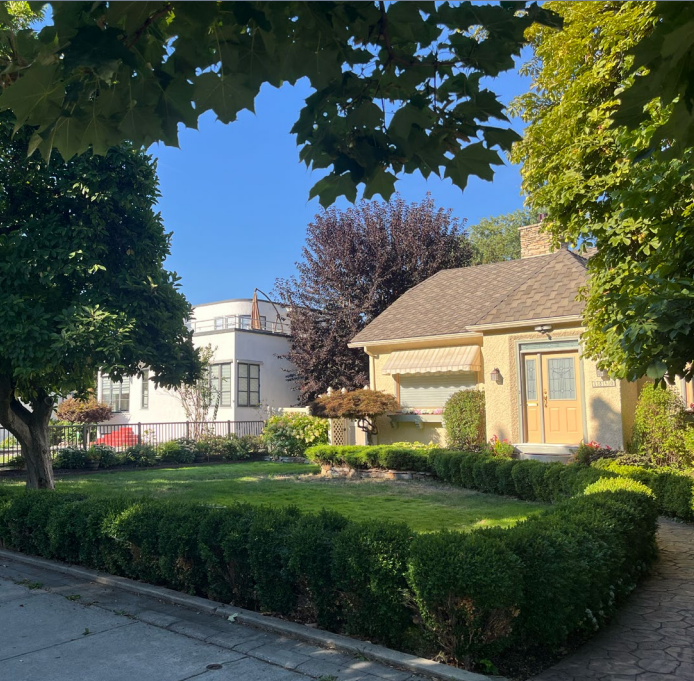
When assessing applications for infill housing developments in the Abbott Street and Marshall Street Heritage Conservation Areas (HCAs), a clear hierarchy of priorities must guide decision. The top priority is the retention of contributory houses, which are crucial to preserving the character and heritage value of the area. Following closely is the retention of mature trees, as they significantly enhance the environmental and aesthetic quality of the HCAs.
Although housing is critically important, the siting and design of infill developments must integrate thoughtfully with the existing context, with a strong emphasis on preserving mature trees whenever possible.
If a mature tree is located in an area intended for an infill unit, alternatives like relocation or in-kind replacement should be considered. However, if a tree is affected by lower-priority features such as parking spaces, garages, or driveways, priority should be giving to tree retention. Staff level delegated variance authority could be used to accommodate tree preservation. In such cases, site planning, parking plans or requirements may need to be adjusted to ensure that development aligns with both housing needs and the preservation of the area's historical and environmental uniqueness and integrity.
 |
The following Principles 1 - distinguishability, compatibility and subordination - form the foundation of the HCA - Conservation and Development Guidelines for new additions or properties. They aim to ensure that new properties and additions are informed by the existing historic character, local topography, urban design, and overall sense of place within the Abbott Street and Marshall Street Heritage Conservation Areas.
An effective approach to implementing these principles involves viewing new additions or infill properties as contemporary compliments to the existing structures. While sharing certain attributes, but in some cases with greater height and scale, these new constructions are intentionally designed to be less ornate or detailed. They are thoughtfully crafted to respect the integrity and prominence of the contributory house, preventing any overshadowing or disruption of their presence.
Applicants should read and understand Design Principles and guidelines when preparing applications for new construction, renovations, or additions within the Heritage Conservation Areas.
1 The Standards and Guidelines for the Conservation of Historic Places in Canada - Standard 11 regarding additions to historic places
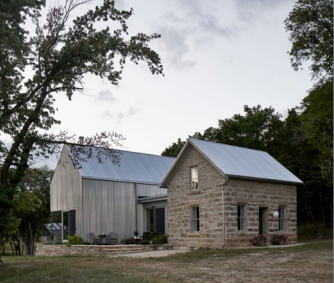
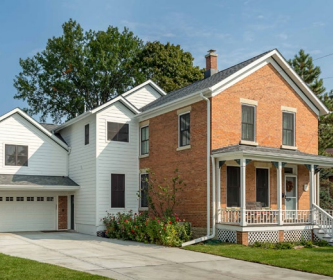
Distinguishability is essential for honouring the historical evolution of an area or property. When designing new infill properties or extensions, it's important to clearly differentiate them from existing structures. This helps observers understand the timeline of construction and changes over time, distinguishing each phase of building. Thoughtful development avoids confusing what is old and what is new by avoiding imitation, preserving the property's story. Passers-by should easily recognize different architectural styles, materials, and periods of construction, whether through subtle or bold design choices.
 |  |
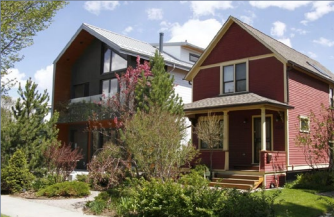
Compatibility does not imply uniformity or replication. New and existing structures can achieve compatibility through various aspects, such as height, roof form, material finishes, or window patterns. For example, structures may share similar heights and forms or differ in these aspects while being compatible in their material finishes. The objective is to create a logical, harmonious, or fitting coexistence. Compatibility can be subtle or bold but should not be so subtle as to create confusion about what is old and what is new.
 | 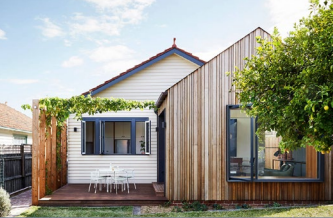 |
Subordination should not be solely interpreted as being smaller; instead, it involves ensuring that an addition or property does not overshadow the historic place. This can be achieved by employing simple finishes, restrained detailing, or a discreet location and colour palette. The addition may even exceed the scale of the historic structure but should function as a canvas or backdrop, enhancing its prominence rather than competing with it.
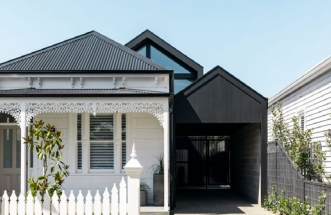 | 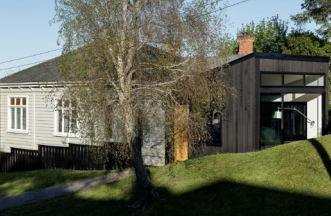 |
Purpose of A Statement of Significance
A Statement of Significance (SOS) is a summary of the historical, cultural, aesthetic, scientific, social, spiritual, and environmental values of an historic place, whether it is an individual property or an area. It contains a description of the historic place and its key features, a summary of the area's heritage values, and a list of character defining elements. Character defining elements are the aspects of an historic area that contribute to its heritage value and that should be retained to preserve this value. The guidelines in the Conservation and Development Guidelines section should be interpreted with reference to the character defining elements in the SOS. It is important to note that the SOS is written through a colonial lens, reflecting the heritage values and priorities of colonial development. Recognizing and integrating Indigenous values and perspectives is a crucial step for a more comprehensive and inclusive understanding of these areas.
Statement of Significance
Description of the Historic Place
The Abbott & Marshall Streets Heritage Conservation Areas (HCAs) are located in the Core Area of the City of Kelowna, British Columbia. It is a residential area dominated by single detached houses comprised of over 360 properties in approximately 36 hectares. Their boundaries are between Mill Creek in the north, Strathcona Avenue in the south, and Okanagan lake in the west. The Abbott Street HCA eastern boundary starts along Water Street, continues along the lane between Knox Crescent and Pandosy Street and ends along Pandosy Street. The Marshall Street HCA spans the entire Marshall Street and includes the first two properties on the north side of Rowcliffe Avenue and the first two on the south side of Buckland Avenue to the east (see Map 23.1: Abbott Street and Marshall Street Heritage Conservation Areas.)
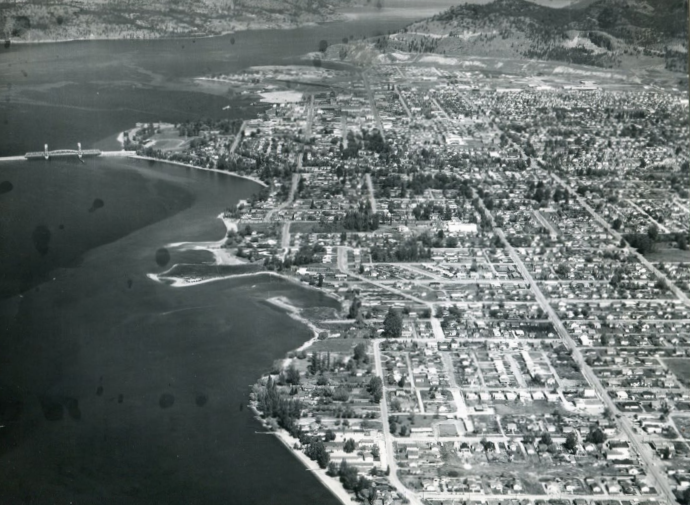 |
| Aerial view of Kelowna and the Okanagan Lake Floating Bridge in the 1960s - Kelowna Public Archives #9761 |
Heritage Values
The Abbott & Marshall Streets Heritage Conservation Areas are located on the traditional territory of the syilx/Okanagan people on the eastern shore of kɬúsx̌nítkʷ (Okanagan Lake), an important and sacred syilx place, invaluable resource and traditional transportation route since time immermorial.
The historic settler residential neighbourhood that was established here between Pandosy Street and Okanagan Lake, south of Mill Creek and north of the hospital in the early 1900s, has been recognized as a historic place for its evident built and scenic character since the Kelowna Heritage Inventory of 1983. Two Heritage Conservation Areas were established within this neighbourhood in 1998, each named after the dominant roadways - Abbott Street and Marshall Street - that traverse them.
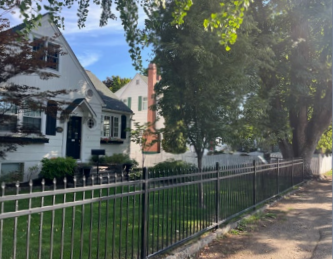 |
The neighbourhood is historically associated with the introduction of modern transportation services in the area (a rail branch line completed between the CPR mainline at Sicamous and Okanagan Landing in 1892 as well as paddlewheeler service connecting various points on the lake) which gave Kelowna ‘townsite’ its important boost to expand towards incorporation as a city and for the local agricultural industry to be established in earnest. First subdivided for farming homesteads in 1904, but adjusted to urban residential lots by 1906, this residential area is valued as a representation of the early and evolving character of Kelowna’s settler inhabitancy pattern along the shores of Okanagan Lake. Its house styles offer a diverse variety of residential architecture dating from the early 1900s right up until today, with various recognizable development booms and architectural trends, often constructed in pleasantly consistent groupings.
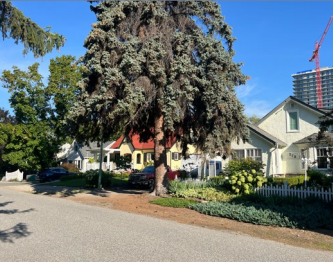 |
The curved or diagonal alignments of certain streets and lanes in the neighbourhood, such as Abbott, Knox, Pandosy and Riverside, were laid out this way due to the proximity and natural shapes of Mill Creek and Lake Okanagan, a unique characteristic of this neighbourhood. The natural, scenic aspects of the area, along with views of the lake along the east-west streets and between some of the houses, have given the neighbourhood an identity as a recreational and tourist destination for visitors and residents alike. It has been called a ‘sanctuary’ by many and is cherished as a green, shady, authentically historic place that is walkable, bikeable, centrally situated, and that offers interesting, educational and pleasant experiences to all - comparable to a public park.
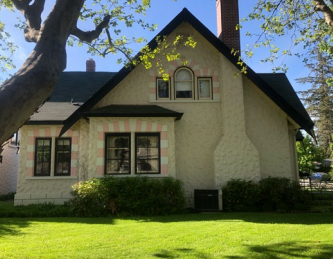 |
The neighbourhood is valued for the way it conveys a unique sense of time and place and for its strong sense of community. Containing the highest concentration of heritage properties in Kelowna, some listed on the Kelowna Heritage Register, others on the earlier 1983 Heritage Resources Inventory, as well as home to dozens of heritage trees and groupings identified on the 1992 Heritage Trees of Kelowna report, the area’s legacy attributes establish a strong heritage character in the neighbourhood. This sense of an established, older neighbourhood comes from the collective presence of extensive, mature landscaping on many properties and along the streets, as well as from the abundance of traditional house styles and property configurations prioritizing pedestrian entrances facing the street, front porches, and inviting, open front yards.
With few exceptions, the residences in this neighbourhood are modest in size and detailing. This is a characteristic that remained even when house styles changed from early 1900 cottages to interwar revival homes to post-war bungalows and onto suburban ranchers. Only in the last two decades, since the establishment of the Heritage Conservation Area bylaw in 1998, have very large homes with multiple car garages become an apparent phenomenon, with the majority of this typology located along the lakeside of Abbott Street, although recently they are appearing in more areas of the HCA. This is a reflection of the changes in housing styles and forms as vehicles became more popular and predominant over time and homes had to be designed to accommodate them.
Recognizing and establishing the heritage value and unique character of this neighbourhood was an effort spearheaded by some Kelowna residents, and this ongoing, preservation-focused advocacy is part of its social and historical narrative. Although initiated decades earlier, heritage recognition of this area was first formalized as part of the Kelowna Heritage Resource Inventory project in 1983 which was supported by staff at the Kelowna Centennial Museum, volunteer members of the City of Kelowna Heritage Advisory Committee, the Central Okanagan Heritage Society, the Okanagan Historical Society, and residents of the neighbourhood (many of whom were/are members of the above-mentioned organizations). It was residents of this neighbourhood who helped to form the Kelowna South-Central Association of Neighbourhoods (KSAN) in 1993, the Friends and Residents of the Abbott Street Heritage Conservation Area Society (FRAHCAS) in 1998, and the Kelowna Tree Protectors in 2016 - community groups that continue to advocate for heritage conservation in this area and beyond.
Character Defining Elements
- Residential form and character as expressed by the one to two-and-a-half storey wood-frame homes, with the majority modestly scaled, and featuring one-and-a-half storey height.
- Typical property siting and scale of residences that allows for clear views between and through properties
- A prominence of traditional house styles, with unique designs, but still featuring common elements such as front porches or stoops, central front doors visible from the fronting street, traditional roof forms (gable, hip, gambrel, flat etc.) prominent or end-wall chimneys, bay and picture windows, wood or stucco cladding and rich, contrasting paint schemes.
- Several precincts that express unique characteristics including Maple Street, Marshall Street and two precincts of early pre-World War I homes.
- Residential front yards often featuring mature landscaping and curved pathways, openly visible from the street.
- Openly visible properties with minimal to no hedges or fencing, allowing a view of the property and the house.
- Car garages are predominated by traditional set back garages.
- An abundance of large, mature trees, both on private and public property, that create a substantial tree canopy in the
neighbourhood. - The natural contours, views and habitat of Mill Creek which delineates the northern border of the neighbourhood.
- Two Mill Creek bridges just south of Harvey Avenue at Abbott and at Water Streets, and the pedestrian/bike access from the neighbourhood to City Park via a tunnel located at the western edge of Lake Avenue - which act as the northern gateways to the neighbourhood and contribute to its accessibility and walkability.
- Public access to Okanagan Lake via seven beach access points in the neighbourhood. Views of the Okanagan Lake from and between properties, especially along Abbott Street.
- Abbott Street Recreation Corridor with its treed boulevard, boulevard gardens, its two-way bike path, separate sidewalk and heritage-style streetlamps.
- The view of lakeside home frontages from the Okanagan Lake beach.
- The view of the home frontages from Mill Creek.
- The country-lane character of some of the neighbourhood due to lack of sidewalks, such as Maple Street, the north side of Lake Avenue, Knox Crescent, the south side of Park Avenue, Vimy Avenue, McDougall Avenue, Long Street.
- The walkability of the neighbourhood with its wayfinding signage, the pedestrian-friendly paths, traffic-controlled streets and access points to the beach, hospital, downtown and City Park.
- The citizen-initiated and funded, weather-proof interpretive plaques outside many of the character homes and significant trees, angled towards the street for the benefit of passers-by.
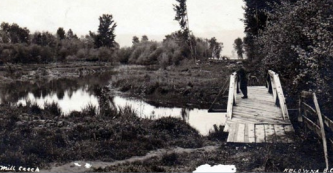 |
| The Abbott Street footbridge over Mill Creek with a view towards what would become Kelowna's City Park in two years. Photo circa 1907. Credit: Old Kelowna Facebook Group |
Purpose of A Statement of Desired Future Character
A Statement of Desired Future Character serves as a roadmap for managing change in a way that respects and enhances the unique historical and cultural significance of the heritage area. The guidelines in the Conservation and Development Guidelines section should be interpreted with reference to the Statement of Desired Future Character. It is important to note that the Statement of Desired Future Character is written through a colonial lens, reflecting the heritage values and priorities of colonial development. Recognizing and integrating Indigenous values and perspectives is crucial next step for a more comprehensive and inclusive understanding of these areas.
Statement of Desired Future Character
The character of the Abbott & Marshall Streets Heritage Conservation Areas is made up of the relatively consistent built form and siting of single detached housing and duplex residences of modest size and detailing, constructed in a diversity of styles from the early 1900s until today. The character is augmented by the abundance of mature trees on both public and private properties, and the many traditional front and side gardens maintained by the residents themselves. The neighbourhood has a non-generic, authentic vibe to it which stems both from the physical aspects of the built and natural elements in it, but also from the unique sense-of-place it offers and for its strong sense of community.
As a neighbourhood which has evolved from the moment it was settled, including several significant development booms that saw the construction of new houses boasting the architectural trends of their time, the subdivision of larger properties into smaller urban lots, the conversion of large dwellings into multi-unit dwellings, and the infilling of developed properties with carriage houses, second dwellings, and additions for secondary suites - this area will continue to gently and thoughtfully densify. This could occur through renovations, house conversions, additions, infill properties, multi-unit properties, Heritage Revitalization Agreements, and further subdivisions where appropriate. New contemporary designs and additions will reflect their era of construction as guided by the Standards and Guidelines for the Conservation of Historic Places in Canada, in keeping with the range of existing properties in the neighbourhood that are easily identifiable and associated with their own decade-specific architectural expression. The retained authentic, historic character of the HCAs, along with a careful, customized approach to development, will continue to provide residents and visitors alike with a unique and valued sense of place into the future while recognizing the OCP’s directions that focus on increased densification and complete communities.
The preservation of the following elements is a priority:
- Contributory houses of all eras and styles (Map 23.2)
- Mature trees on private properties and in the public domain.
- The small-scale, single detached housing form and footprint of the street-fronting properties, whether contributory or not.
- The open visibility of the properties through low, or the absence of property fences.
- The traditional design prioritization of pedestrian use and entrances on the front and side elevations of homes, with car garages or carports at the back or accessed from the lane.
- The inviting, accessible, recreational uses in the neighbourhood such as the bike and walking paths, the interpretive plaques, the beach access points, the views of the lake and the shaded sanctuary of the mature trees.
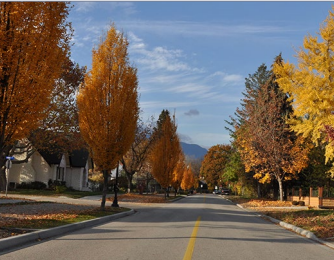 | 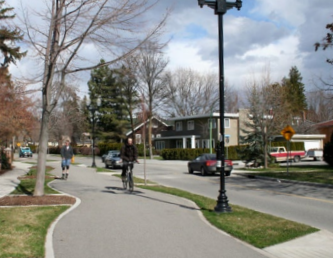 |
Kelowna’s Heritage Conservation Areas are composed of five distinct precincts, each with its own unique characteristics and historical significance. These precincts collectively contribute to Kelowna’s heritage, reflecting the diverse architectural styles, histories, and community values that have shaped the city over time. By recognizing these precincts, Kelowna aims to maintain its historical integrity while promoting a sense of place and continuity for future generations. The precincts identified in the Heritage Conservation Areas include:
- Marshall Street Precinct*
The Marshall Street precinct’s heritage character is created by the presence of the W.J. Marshall House at 1869 Marshall Street, along with smaller, traditional houses along both sides of Marshall Street, from Buckland Avenue to its termination at Mill Creek, and the partial blocks of Rowcliffe and Buckland Avenues to the east. The precinct comprises 25 properties which all, individually and collectively, contribute to its character. 1869 Marshall Street was built in 1908 and is protected through a heritage designation bylaw. The remainder are smaller historic houses, built between 1929 and 1950, except the Care Centre at 1820 Marshall - built in 1999, 1868 Marshall built in 1990, and 1882 Marshall built in 1965. Collectively, the overall property character, relatively consistent scale, siting, shallow front-yard setbacks, street trees and mature property landscaping, and the narrow street culminating at a cul-de-sac at the creek, make the precinct a distinctive island of houses within the multi-unit, institutional and commercial land uses surrounding it. Mill Creek, which flows along the western and southern edge of the precinct is an important contributory feature.* From a heritage values and character perspective, this area is a distinct precinct. From a legislative perspective, the Marshall Street Heritage area has been and continues to be a Heritage Conservation Area.
- Early Homes Precinct #1 Park Avenue and Pandosy Street
This is one of two areas with a concentration of the earliest grouping of homes built in the neighbourhood before World War I, including those on the 400 block of Park Avenue - the 1905 Buck House, the 1905-1909 Joyce Hostel property, the early cottage at 467 Park Avenue, the 1908 Reekie House, as well as on the north side of the 300 block of Park Avenue with 386 Park Avenue (c. 1908), 374 Park Avenue (1910), 366 Park Avenue (c.1913) and the c. 1903 Temple House. This precinct also includes 377 Beach Avenue (c. 1911), 2024 Pandosy Street (1908) and 2034 Pandosy Street (1907) which are protected through a heritage designation bylaw. These homes are diverse in size, style and sitting, reflecting the first isolated, settlement efforts carried out in what was at the time a completely undeveloped area with minimal infrastructure.
- Early Homes Precinct #2 Abbott Street from Lake to Beach Avenues
This area contains one of the two earliest clusters of homes constructed in the neighbourhood prior to World War I, including those on the east side of the 1900 block of Abbott Street - 1923 Abbott Street (1910), the McWilliams House at 1931 Abbott Street (1909), the Murdoch House at 1957 Abbott Street (1913), 1961 Abbott Street (c.1909) and 1967 Abbott Street (c.1909). Also included across the street are the Jackson House at 236 Beach Avenue (1910) and 278 Beach Avenue (1908), and at the north edge of the precinct, the 1910 Haldane House at 263 Lake Avenue. These homes are diverse in size, style and sitting, reflecting the first isolated, settlement efforts carried out in what was at the time an undeveloped area with settler homes and with minimal infrastructure.
- Maple Street Precinct
The single block of Maple Street is unique in that all 16 properties were developed within a short time-period, the vast majority in the 1940s with only a few shortly before or after. The houses are inspired by house pattern books of this decade and are very consistent in scale, siting and finishes - almost all are 1.5 storey homes, aligned in siting, with central entrances and side-gabled roofs. None of the homes has been demolished or unrecognizably transformed since construction, making this an integral block of the HCA. The streetscape itself has a country-lane feel to it because it features extremely large street trees, mostly maple trees, from the beginning to the end of the block on both sides and has no pedestrian sidewalks. This allows pedestrians and vehicles to share space and creates a low-speed vehicular environment. These consistent and unique features give this precinct its one-of-a-kind character.
- Custom Mid-Century Modern Precinct
A rare grouping of four flat-roofed 1950s Modernist home designs on the 300 block of Burne Avenue associated with a local architect and builder. Some redevelopment of adjacent properties has occurred in recent years, reducing the number of consistently designed Modernist homes that remain.
The established guidelines apply to all properties in the HCA, ensuring a cohesive and standardized approach to property development and preservation. These guidelines provide a foundational framework that upholds the historic integrity and continuity of sense-of-place in the HCAs. The Standards and Guidelines for the Conservation of Historic Places in Canada (Parks, 2010) serve as the basis for Kelowna’s HCA - Conservation and Development Guidelines. Specific reference should be made to Standards 11 and 12 (below).
- (Standard 11) Conserve the heritage value and character defining elements when creating any new additions to a historic place and any related new construction. Make the new work physically and visually compatible with, subordinate to and distinguishable from the historic place.
- (Standard 12) Create any new additions or related new construction so that the essential form and integrity of a historic place will not be impaired if the new work is removed in the future.
Specific guidelines tailored for contributory properties can be found under supplemental sections titled “contributory”, which address the unique considerations necessary for conserving their heritage value and maintaining a property’s contributory status.
Guidelines for properties located within the Hospital Transit-Oriented Area (TOA) are outlined in Chapter 18 – Form and Character, Section 4.0 Low & Mid-Rise Residential & Mixed-Use Units of the Official Community Plan (OCP). Additional guidance is provided in the supplemental sections titled “TOA,” as mandated by the Bill 47 Housing Statutes (Transit-Oriented) Amendment Act. The TOA within the Heritage Conservation Area (HCA) is a technical boundary defined by proximity to transit routes. All blocks within the TOA of the HCA are of heritage importance, just like areas outside of the TOA, and are described in the neighbourhood Statement of Significance (SOS). Heritage conservation is a priority within the TOA and are eligible for incentives offered for the retention of contributory properties, similar to properties outside the TOA.
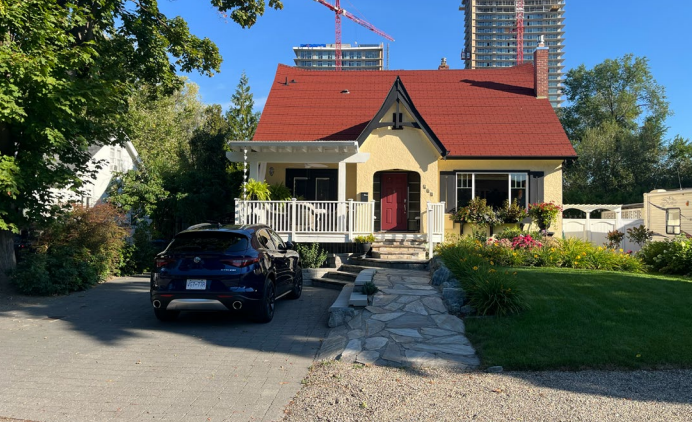
Applicants are encouraged to gather as much historical information as possible before undertaking any alterations. Historic photos, archival records, and a careful examination of the property itself often yield valuable clues regarding the original appearance, materials, chronology of alterations, lost details, and placement of colors. This is especially true for signature elements like windows and doors.
 |
Intent
To preserve, celebrate and maintain the heritage values and sense-of-place of the HCAs through the incentivization of the conservation of contributory properties and streetscapes, while ensuring new development is thoughtful, compatible and subordinate.
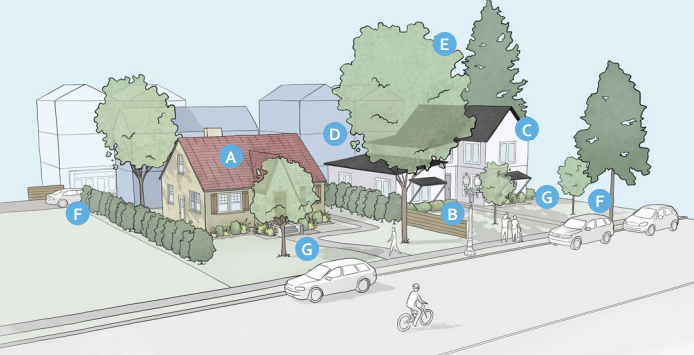 |
To achieve the objectives of HCA - Conservation and Development Guidelines, all development must be informed by the unique historic context and/or distinct precinct it is in, and:
A Maintain the character defining streetscapes by preserving the original form, scale, massing, and finishes of contributory houses.
B Maintain the historic, consistent and/or average siting of street-fronting properties on a given block.
C Retain the single-dwelling form, footprint and (up to 2 storey) height for street-fronting properties, both for existing and new construction, even if they contain multiple units.
D Ensure all alterations, additions, and new properties are visually compatible with, subordinate to and distinguishable from the existing context and the historical design of adjacent properties. Additions and infill properties (up to 3 storeys) should ideally be sited behind contributory houses. Avoid directly mimicking contributory houses to maintain clarity between historical and contemporary elements.
E Preserve the established tree canopy to maintain the neighbourhood’s heritage values, natural beauty and environmental benefits.
F Prioritize pedestrian-oriented design with all vehicle access taken from the lane if available. Ensure the portion of any building facing the street facilitates easy access for pedestrians to front entrances from the street. Avoid blank walls at street level to create a more engaging and welcoming streetscape. Property walls, solid gates and hedges above 1.2 meters are not permitted.
G Ensure onsite landscaping and the off-site frontages contribute to the urban livability and historical design of the neighbourhoods by promoting the conservation or introduction of mature yard plantings, curved pathways and traditional landscaping approaches that enhance the public visibility of properties.
Intent
To maintain the character defining streetscapes by respecting the historic, consistent and/or average siting of street-fronting properties, hardscaping and landscaping elements on a given block. Preserve the original form, scale, massing, and finishes and layouts of contributory properties. Maintain the substantial tree canopy in the neighbourhood, including mature and large trees and other plantings, both on private and public property.
Guidelines
1. Assess and understand the unique streetscape of the block where the property is located, especially the specific side of the block. Consider the average or typical character of the block and property when planning development, changes, or maintenance.
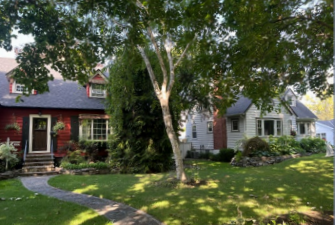 |
| Figure 1: Assess and understand the unique streetscape of the block where the property is located, especially the specific side of the block. |
2. Consider aspects such as typical property siting, distance between properties, typical property form and size, consistent or unique street trees, sidewalks (or lack thereof), public infrastructure, and other unique tangible and intangible aspects of the block to inform the proposal.
3. Check if the property is located in an HCA Precinct (see Map 23.3), and if it is, follow the streetscape and other guidelines specific to it.
Intent
To permit thoughtful change and development on the interior, side and rear elevations of contributory houses on contributory properties, changes must retain or enhance the unique heritage character of the property. New street-fronting properties should reflect the neighbourhood’s traditional single-dwelling form, footprint and (up to 2 storey) height. Three storey structures should be sited at the rear of properties or set back from the street-fronting properties.
Guidelines
1. Support house conversions within contributory houses to achieve additional units and uses, fostering change and growth while conserving the historic properties and character of the HCAs.
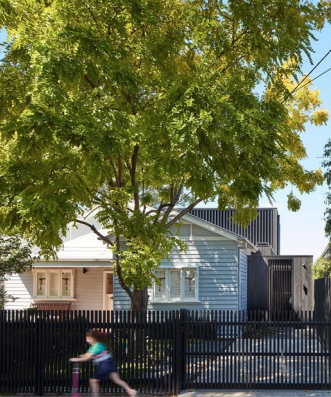 |
| Figure 2: Support house conversions within contributory houses to achieve additional units and uses, fostering change and growth while conserving the historic properties and character of the HCAs |
2. Set back additions to contributory houses sufficiently to preserve the prominence of the historic property, ensuring that the original form remains prominent from the public realm.
3. Consider the relocation of a contributory house or feature, if necessary, to allow room for additions or infill properties while maintaining or enhancing the visibility of the contributory house or feature.
4. Vary rear setbacks from the established pattern within the limits of the Zoning Bylaw to accommodate additions to the existing property footprint and enable infill properties at the rear of the properties. Variances to development regulations may be considered.
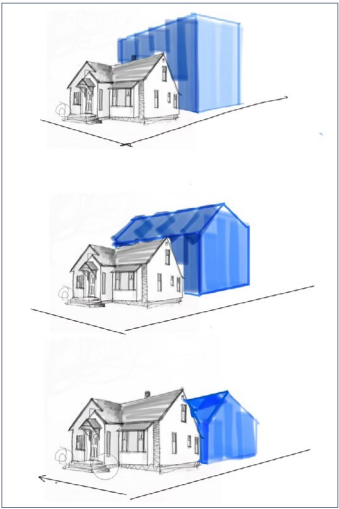 |
| Figure 3: Vary rear setbacks from the established pattern within the limits of the Zoning Bylaw to accommodate additions to the existing property footprint and enable infill properties at the rear of the properties. Variances to development regulations may be considered. |
5. Ensure that spacing between properties allows for ample light penetration and small view corridors from the public street.
6. Mimic the siting of contributory houses for new residences to follow the established development patterns in the neighbourhood.
7. Maintain front yard setbacks within 10% of the adjacent or average property setback on the same side of the block.
8. Position new structures including additions, infill properties, carriage houses, garages and carports, to be set back from or located behind the street-fronting property line. In the case of a wide lot, it may be appropriate to position additions, infill properties and carriage houses next to or in line with the existing house.
9. Reduce neighbour overlook by locating second storey or third storey outdoor spaces in context sensitive siting to preserve privacy for neighbours.
10. Site coverage should be responsive to the neighbouring property massing and open space. In the case of a large lot, the maximum site coverage should be achieved through more than one structure, to retain the typical scale of houses and structures in the neighbourhood and allow for open space between them.
11. Oversized street-fronting homes are not supported, as they disrupt the consistent character of modestly-scaled homes long-established and implemented up until 1998. Oversized homes create long elevations that obscure the view between and through properties which is a character defining element of the neighbourhood, and negatively impact the sense-of-place desired for conservation.
12. New front driveways and garage doors facing the street are not supported where rear lane access is available. Where no lane is available, front drives with rear garages are permitted.
13. Snout houses and the introduction of garages into existing street-fronting properties are not supported, whether contributory or not.
14. Plan site development to retain large trees and identified mature trees in situ. Variances to select development regulations may be considered to retain existing mature trees. Tree protection measures during construction may be required.
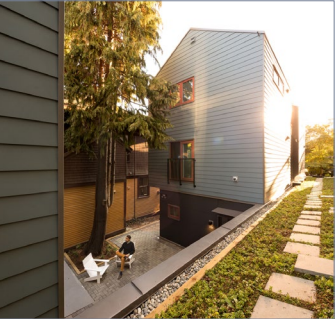 |
| Figure 4: Plan site development to retain large trees and identified mature trees in situ. |
15. Limit impermeable surfaces in landscaped areas and open spaces to maximize stormwater infiltration. Respect the Okanagan Lake floodplain and Mill Creek floodplain which set minimum property elevations for construction.
Intent
To ensure the provision of adequate servicing, vehicle access, and parking in a manner that maintains and enhances the traditional pedestrian-focused property and property designs of the area. The historic neighbourhood was not designed around cars, and when a historic garage was built, it was always at the rear and discreet in size and siting.
Guidelines
1. Prioritize traditional pedestrian design by retaining or applying street-facing pedestrian entrances, stoops, and porches on the front and side elevations of homes.
2. Retain on site car garages or carports at the back or to be accessed from the lane. Where there is no lane, access to a garage or carport from the front street is permitted, if the entrance is well behind the street-fronting property line to diminish the impact of garages facing the street. Properties should be designed such that habitable space faces the street to encourage a lively pedestrian experience. New snout houses and garage additions on the front of existing properties will not be permitted.
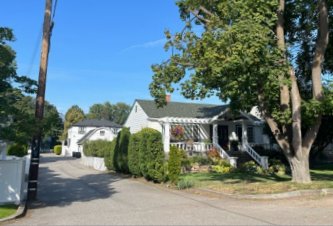 |
| Figure 5: Retain on site car garages or carports at the back or to be accessed from the lane. |
3. Ensure that site layouts include provision for solid waste pick-up and bin storage that is enclosed or otherwise screened from view.
4. Use permeable paving materials and soft and soil-based landscaping to enhance the appearance of driveways, parking areas and to reduce their visual and environmental impact.
5. Ensure that pedestrian pathways are clearly defined, safe, shaded through tree plantings or awnings, and accessible, with priority given to pedestrian movement over vehicular access. Artificial lighting may be used to enhance pedestrian pathways.
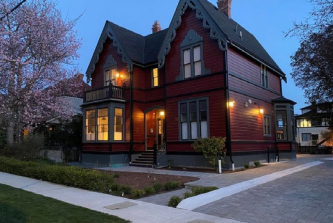 |
| Figure 6: Ensure that pedestrian pathways are clearly defined, safe, shaded through tree plantings or awnings, and accessible, with priority given to pedestrian movement over vehicular access. Artificial lighting may be used to enhance pedestrian pathways. |
6. Enhance the “lanescape” by orienting additional units located towards the rear of the property to face laneways, and use property entrances, lighting, landscaping, and materials to reinforce a safe and attractive public realm.
TOA Guidelines
For properties in the Hospital Transit-Oriented Area (TOA), guidelines can be found in Chapter 18 of the OCP, Section 4.0 – Low & Mid-Rise Residential & Mixed-Use Units. The permitted build form may conflict with the established character of the neighbourhood, making a subordinate design essential for a successful proposal. Please refer to the design principles in Section 4.0 for guidance.
7. Design properties that align with the neighbourhood’s traditions of pedestrian entrances facing the street and that are modest in size and detailing. On an apartment building this could be achieved by including townhouses with individual street-facing entrances, gardens and patios at street level and/or a distinguishable articulation of the first or second storey in a unique design, setback and colour, to maintain the historic animation of a streetscape of homes.
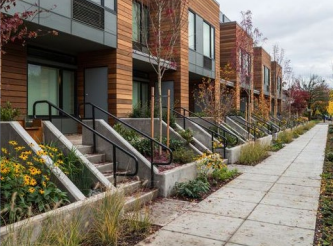 |
| Figure 7: Design properties that align with the neighbourhood’s traditions of pedestrian entrances facing the street and that are modest in size and detailing. |
Intent
To preserve the original form, scale, massing, and finishes of contributory houses while guiding new street-fronting properties to be visually compatible with, subordinate to and distinguishable from contributory houses and properties.
Guidelines
1. Maintain a small-scale, single-dwelling form appearance, even with multiple units, for both new and existing street-fronting properties, including additions, with a maximum height of 2 storeys. Do not add parapets or solid railing walls around rooftop patios right at the property face, as this creates a false sense of height or massing which disrupts the intended streetscape character. Rooftop structures (such as elevator accesses) should be set back from the property face for the same reason, so as not to create a false front or height above the maximum allowed 2 storey height.
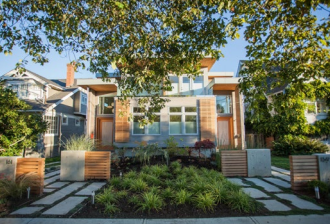 |
| Figure 8: Maintain a small-scale, single-dwelling form appearance, even with multiple units, for both new and existing street-fronting properties, including additions, with a maximum height of 2 storeys. |
2. New street-fronting property proportions and heights should reflect the consistent existing context, as the majority of contributory houses in the HCAs are horizontal in proportion and one to two storeys in height.
3. Allow additions, infill, and accessory properties to reach up to 3 storeys, provided they are set back from or positioned behind the street-fronting residences.
4. New houses, infill properties, carriage houses and garages as well as new additions to contributory houses, should meet the requirements of Standard 11 for ‘additions to historic places’ in that they should be “visually compatible with, subordinate to and distinguishable from” the contributory house they are added to, behind or adjacent to. This means they do not precisely mimic the form and finishes of the contributory house, even if they are attached to it.
5. Design new construction on vacant lots or demolished properties to reflect contemporary architectural styles rather than directly mimicking historic designs. This approach helps avoid confusion about what is historic and what is new, while integrating with the established neighbourhood following the HCA - Conservation and Development Guidelines.
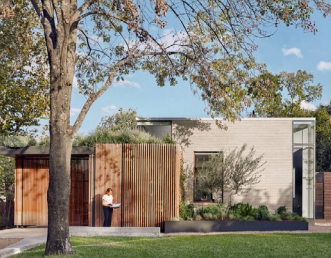 |
| Figure 9: Design new construction on vacant lots or demolished properties to reflect contemporary architectural styles rather than directly mimicking historic designs. |
6. New property designs should embrace the diversity of house styles and finishes in the HCAs, avoiding repetition and encouraging variation between properties.
Contributory Property Guidelines
7. Research and understand the original property form and design tradition of its historic era to best conserve its form, massing and architectural details.
8. Avoid damaging or obstructing historic character defining features when constructing additions.
9. Use links, breezeways, insets, or offsets for side and rear additions to connect to the historic property, distinguishing their massing from the original house.
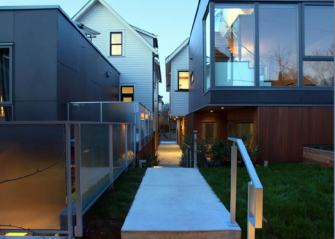 |
| Figure 10: Use links, breezeways, insets, or offsets for side and rear additions to connect to the historic property, distinguishing their massing from the original house. |
10. Design basement additions without raising the historic floor level, except where necessary to respect the floodplain and meet minimum property elevations, ensuring the new level does not significantly exceed neighboring conditions.
11. Focus on rear additions or setback side additions, particularly on wider lots, rather than adding full-floor second-storey additions that obscure the original structure’s form.
TOA Guidelines
For properties in the Hospital Transit-Oriented Area (TOA), guidelines can be found in Chapter 18 of the OCP, Section 4.0 – Low & Mid-Rise Residential & Mixed-Use Units. The permitted build form may conflict with the established character of the neighbourhood, making a subordinate design essential for a successful proposal. Please refer to the design principles part of this document for guidance.
12. Ensure that any new small-scale apartment properties (up to 6 storeys) within the TOA boundary meet the requirements of compatibility with distinguishability from, and subordination to the surrounding heritage context. Given that these properties will exceed the height of existing historic structures, special attention must be paid to the requirement for subordination.
Refer to the Design Principles section for guidance on achieving these objectives.
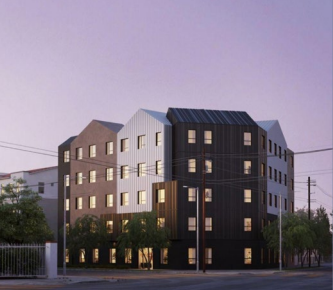 |
| Figure 11: Ensure that any new small-scale apartment properties (up to 6 storeys) within the TOA boundary meet the requirements of compatibility with distinguishability from, and subordination to the surrounding heritage context. |
13. Design properties that reflect contemporary styles while respecting the existing context of the HCA. Avoid mimicry of heritage details from previous decades.
14. Design properties that align with the neighbourhood’s traditions of pedestrian entrances facing the street and that are modest in size and detailing. On an apartment building this could be achieved by including townhouses with individual entrances, gardens and patios at street level and/or a distinguishable articulation of the first or second storey in a unique design, setback and colour, to maintain the historic animation of a streetscape of homes (see examples).
Intent
To celebrate and prioritize good craftsmanship, material longevity, and a culture of repair and maintenance. To emphasize neighbourhood character, visual interest, and a sense of place. To recognize the heritage value of traditional materials, as well as the importance of newer, sustainable, and fire-safe materials that respect and complement the heritage context.
Guidelines
1. For primary facing material - use durable, fire-resistant, or non-combustible materials for new buildings within the HCAs, including smooth finished fiber cement siding and shingles, fiber cement panels and stucco cladding. For accent facing materials - brick, stone and metal cladding can be used.
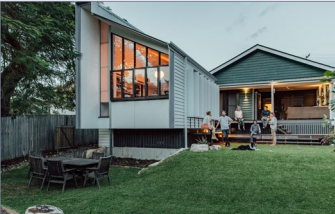 |
| Figure 12: Use durable, fire-resistant, or non-combustible materials for new properties within the HCAs, including smooth finished fiber cement siding and shingles, fiber cement panels, stucco cladding, and metal cladding. |
2. Prohibit the use of combed, brushed or textured lumber, textured wood or “wood grain” fiber cement sidings, unpainted clear stained wood siding, vinyl or plastic sidings, and brick or stone as a primary facing material for new properties and additions in the HCAs due to their lack of compatibility.
3. Reflect the diversity of house styles and finishes in the HCAs by avoiding repetitive new property designs and encouraging variation between properties.
Contributory Property Guidelines
4. Preserve the original property finishes, wherever possible, through regular repair, maintenance, restoration, and reuse.
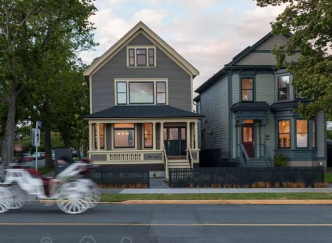 |
| Figure 13: Preserve the original property finishes, wherever possible, through regular repair, maintenance, restoration, and reuse. |
5. Adhere to Conservation Guideline 15 under Materials and to Guidelines 1 and 2 of this section (above) when altering a property finish, regarding permitted and non-permitted finishing materials.
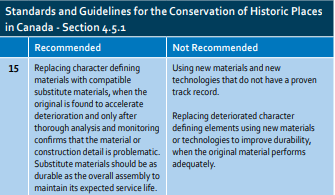 |
| Figure 14: Adhere to Conservation Guideline 15 under Materials and to Guidelines 1 and 2 of Section 1.5 when altering a property finish, regarding permitted and non-permitted finishing materials. |
6. Use replica materials from the permitted list above when original finishes are irreparable or unsuitable (e.g., for environmental or economic reasons). Ensure that these materials match the dimensions and appearance of the originals and install them according to the original pattern and exposures documented on the contributory house.
7. Preserve windows of contributory houses through regular maintenance. Repair painted shut or non-operable windows. Enhance energy efficiency with weather stripping and consider external wood storms or interior storm windows. If original windows cannot be repaired or operate efficiently and the property is not protected by heritage designation, replace with double-glazed replica units matching historic dimensions and design. Use “true divided lights” for divided-light windows.
8. Retain, repair, and restore original doors, transoms, sidelights, and hardware whenever feasible. Replace doors with replicas or salvaged units of identical dimensions and design when necessary.
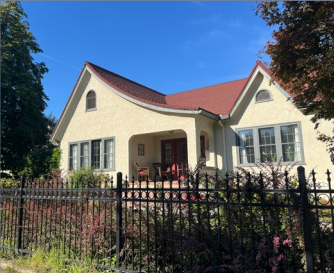 |
| Figure 15: Retain, repair, and restore original doors, transoms, sidelights, and hardware whenever feasible. |
9. Maintain the original front entrance of contributory houses, even when converted or extended. Ensure new entrances do not diminish the visual prominence of the original entry.
Intent
To preserve the abundance of large, mature trees, both on private and public property which create a substantial tree canopy in the neighbourhood, as well as the mature yard plantings, curved pathways and traditional landscaping approaches that enhance the public enjoyment of properties.
Guidelines for All Trees
1. Plan site development to enhance the tree canopy cover across both private and public spaces within HCAs. Variances to select development regulations may be considered to incentivize the retention of trees.
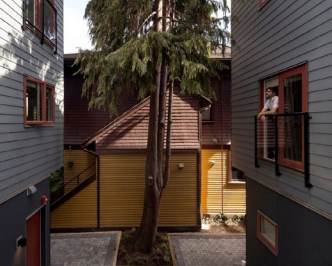 |
| Figure 16: Plan site development to retain identified mature trees in situ. |
2. Engage a Certified Arborist to conduct a Pre-Development Tree Inventory as per Bylaw No. 12310 – Development Application and Heritage Procedures Bylaw, Schedule 1.
3. Tree protection measures during construction will be required. Protect and water retained trees on site and on neighbouring properties as per requirements of Bylaw No. 12310.
4. Tree condition assessments must be conducted by a Certified Arborist. If a tree cannot be retained due to health issues or location, replace it with a tree that will grow to a similar size or explore on-site relocation. Under the Arborist’s guidance, replacement with several smaller trees that collectively replicate the total canopy coverage of the removed tree at maturity can be considered.
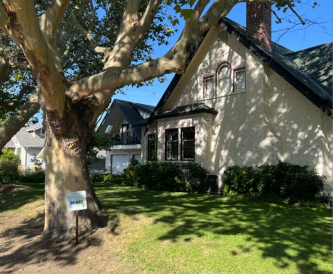 |
| Figure 17: Retain existing mature and large trees on-site and on neighbouring properties, where feasible. |
Guidelines for Hardscaping
5. Many properties in the HCA feature historic hardscaping elements such as curved pathways, stone or concrete retaining walls that contribute to the heritage value of the property and the streetscape of their block. Research and understand the role these elements play in the character of the property and conserve them through regular repair and maintenance and/or when planning changes or development.
6. Walkways from the street to the house, towards the side and backyard, should be distinct from driveways through different paving materials or treatment, or through separation. This enhances safety and the perception of a pedestrian-friendly, walkable neighbourhood. Extend the main entry walkway to the City sidewalk or curb with the same paving material, where possible.
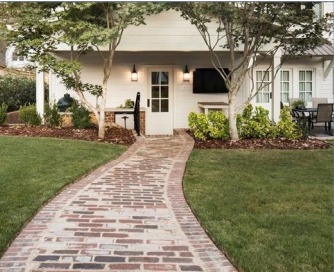 |
| Figure 18: Walkways from the street to the house, towards the side and backyard, should be distinct from driveways through different paving materials or treatment, or through separation |
7. Design new landscapes and developments to harmonize with and respect the overall landscape character of the HCAs. Integrate new elements in ways that enhance rather than detract from the area’s heritage value.
8. Create residential-focused landscapes that prioritize pedestrian safety and enhance the streetscape interface to foster a pleasant walking environment.
9. As per FireSmart best practices use decorative rocks, stone pathways, and rock retaining walls instead of wood for your hardscaping materials.
Guidelines for Landscaping
10. Conserve existing landscaping plantings and forms with exceptions for landscaping that has fire risks or does not adhere to height guidelines (e.g. high hedges).
11. Design new landscapes and developments to harmonize with and respect the overall landscape character of the HCAs. Integrate new elements in ways that enhance rather than detract from the area’s heritage value.
12. Create pedestrian-focused landscapes that prioritize pedestrian safety and enhance the streetscape interface to foster a pleasant walking environment.
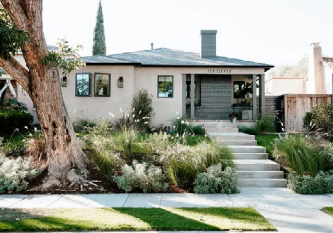 |
| Figure 19: Create residential-focused landscapes that prioritize pedestrian safety and enhance the streetscape interface to foster a pleasant walking environment. |
13. Enhance property entrances, soften property edges, screen parking areas, and mitigate long facades with strategically placed landscaping features.
14. Foster FireSmart and sustainable practices by selecting FireSmart, drought tolerant and native species trees and plants and those that promote biodiversity. Avoid planting conifers, especially cedars and junipers for their flammability and water consumption.
15. Rooftop patios on apartment properties should include shade elements like trees, pergolas and other features that reduce the urban heat island effect.
Guidelines for Fences and Property Walls
16. Historically, fences in the HCAs were only used symbolically rather than for security or privacy, thus treating front yards as a semi-public visual open space for neighbours and passersby to enjoy. Therefore, elements along the front property line must either be low (under 1.2 meters) and/or permeable (with gaps allowing filtered views inward). These elements could include plantings, fences, trellises, stone walls, and more.
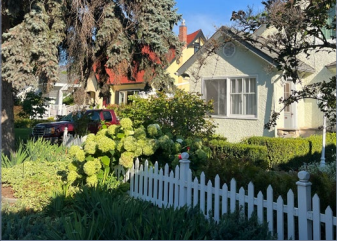 |
| Figure 20: Elements along the front property line must either be low (under 1.2 meters) and/or permeable (with gaps allowing filtered views inward). These elements could include plantings, fences, trellises, stone walls, and more. |
17. New solid property walls, whether masonry, concrete, or metal, are not allowed in the HCAs.
18. Limit new fences, hedges, or screening landscaping to a maximum height of 1.2 m. When replacing taller fencing, walls, gates, or hedges, ensure new permitted installations adhere to this maximum height requirement in the Zoning Bylaw.
Intent
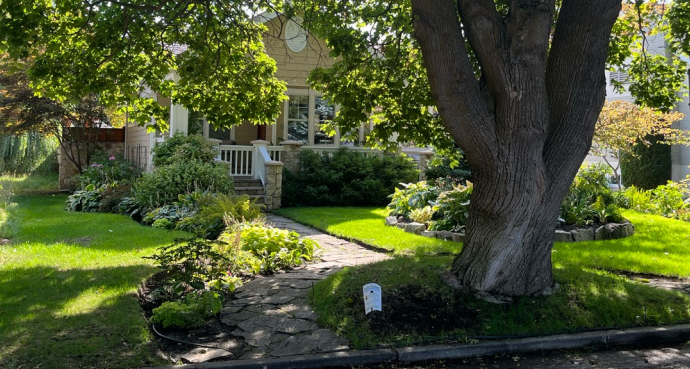
To ensure that development within each precinct respects and enhances the unique characteristics that define the area, contributing to a cohesive and historically sensitive environment.
 |
General Precinct Guidelines
1. Alterations, additions, and new properties should be informed by the unique characteristics of distinct precincts, where relevant.
2. The Maple, Marshall and Custom Mid-Century Precincts are especially characterized by consistent massing, siting and scale. The interruption of these with a proposal that involves a street fronting property that is out of massing, siting or scale with the precinct pattern would negatively impact the entire precinct and would thus not be supported.
3. The two Early Home Precincts are valued for their concentrations of early homes in certain pockets, indicative of the development patterns in the neighbourhood. Although these precincts aren’t characterized by consistent siting, house styles or even scale, the grouping of these contributory houses is especially valuable, and for this reason their conservation in situ will be prioritized and expected in Heritage Alteration Permits in these precincts.
Marshall Street Precinct Guidelines
4. Proposals should maintain the average/consistent scale and massing of the precinct homes (although rear additions or infill properties could differ where appropriate), setback relationship to the street, mature trees and lack of property walls and hedges.\
Early Homes Precinct #1 - Park Avenue and Pandosy Street Guidelines
5. Proposals in the Early Homes Precinct # 1 should prioritize the conservation in situ of the precinct properties and should not involve the reduction of their visibility via relocation or new construction that obscures their view from the street.
Early Homes Precinct #2 - Abbott Street from Lake to Beach Avenues Guidelines
6. Proposals in the Early Homes Precinct #2 should prioritize the conservation in situ of the precinct properties and should not involve the reduction of their visibility via relocation or new construction that obscures their view from the street.
Custom Mid-Century Modern Precinct Guidelines
7. Proposals in the Custom Mid-Century Modern Precinct should involve the conservation of the four precinct properties with their unique flat-roofed, Modernist design.
8. Rear additions or infill properties should be distinctly readable as separate and contemporary, so that the unique 1950s design is preserved. Proposals should preserve the high visibility of the properties, the mature trees and the lack of property walls and hedges.
There is an increasing recognition of the need for sustainable building practices and energy conservation. Heritage conservation inherently contributes to sustainability objectives, as conservation minimizes demolition, preserves existing land use patterns and infrastructure, conserves embodied energy and greenhouse gas emissions, reduces landfill pressure, and mitigates the impacts of new construction.
While new properties must meet mandated energy performance standards (e.g., Energy Step Code), existing properties can achieve sustainability objectives through performance upgrades. Enhancing the energy efficiency of contributory houses in the HCA without compromising their character defining elements is feasible. Balancing heritage conservation with performance upgrades is essential, ensuring that energy improvement measures for heritage properties are assessed against the Standards and Guidelines for the Conservation of Historic Places in Canada (Parks, 2010):
- Add new features to meet sustainability requirements in a way that respects the exterior form and minimizes impact on character defining elements. Collaborate with sustainability and conservation specialists to find solutions that have the least impact on the property’s heritage value.
- Comply with energy efficiency objectives while minimizing impact on the character defining elements and overall heritage value of the historic property.
- Weigh the environmental impact of energy-saving measures against the environmental impact of retaining the existing features or fabric when deciding whether to proceed with energy-saving measures.
In addition to the considerations outlined in the Standards and Guidelines, the following sustainability guidelines should be considered as part of the development process.
Guidelines
1. Integrate sustainable practices in the preservation and maintenance of contributory houses.
Existing Materials
2. Retain existing materials whenever feasible.
3. Preserve as much of the existing property envelope materials as possible, including siding.
4. Retain original window sashes and doors whenever possible. If replacement is necessary, use replicas of the originals.
5. Deconstruct properties instead of demolishing them to salvage materials for reuse and re-manufacturing.
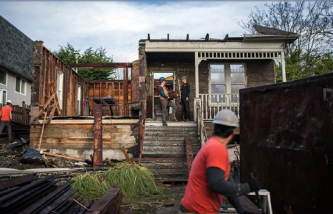 |
| Figure 21: Deconstruct properties instead of demolishing them to salvage materials for reuse and re-manufacturing. |
6. Achieve thermal efficiency by repairing and maintaining existing wooden windows. Installing wood-framed storm windows can further improve thermal efficiency and provide sound abatement.
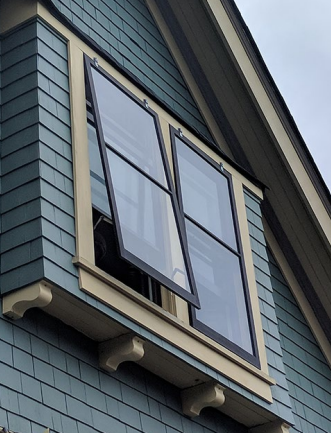 |
| Figure 22: Achieve thermal efficiency by repairing and maintaining existing wooden windows. Installing wood-framed storm windows can further improve thermal efficiency and provide sound abatement. |
Thermal and Energy Performance
7. Upgrade mechanical systems to improve thermal performance. Install new, properly sized electric heat pumps, boilers, hot water tanks, and energy-efficient appliances that meet Energy Star ratings or higher. In heritage homes without existing ductwork, mini-split heat pumps can be an energy efficient heating option, with the added benefit of air conditioning.
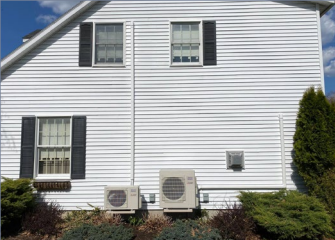 |
| Figure 23: Upgrade mechanical systems to improve thermal performance. Install new, properly sized electric heat pumps, boilers, hot water tanks, and energy efficient appliances that meet Energy Star ratings or higher. |
8. Enhance insulation, particularly in attic and basement spaces. Insulation can also be blown into the cavity of a wood frame wall. When upgrading insulation in older homes, it’s also important to have a sufficient vapor and air barrier.
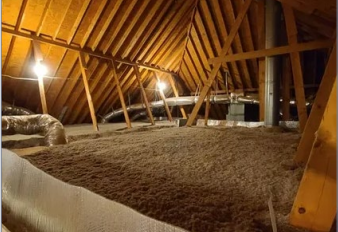 |
| Figure 24: Enhance insulation, particularly in attic and basement spaces. |
9. To preserve heritage aesthetic, considering fixing existing windows and/or installing storm windows.
10. Implement weather-stripping and other draft-proofing measures to reduce energy loss.
Solar Panels
The installation of solar panels should not detract from the heritage value of the property.
11. Installation of less bulky system, flush with the roofline, are preferred.
12. Solar panels, tanks and other infrastructure free of the display of any form of private advertising or branding.
13. Ensure that installation of solar panels maintains or enhances the structural integrity of the property.
14. Place solar panel installations on property elevations, roof planes, or ground locations that respect the landscape and minimize visibility from the street. Appropriate locations include:
- Rear of the property
- On new properties or additions
- On a single roof plane (avoid multi-plane solutions)
- Behind architectural features
- Away from the edge for flat roofs
- Low to the ground
- In interior side yards
 |
| Figure 25: Place solar panel installations on property elevations, roof planes, or ground locations that respect the landscape and minimize visibility from the street. |
15. Ensure that the installation of panels does not require visible structural modification of the roof.
16. Install any necessary frame or structural elements in a reversible (non-permanent) manner. Coordinate the color of these structures to blend with the existing roof color and minimize reflection to neighbours. Roof shingles should be two-toned in a mid-range color to improve energy efficiency in the Okanagan climate. Black roofs are not recommended.
17. Consider future technical innovations that may be suitable for a heritage property, such as integrating solar-cell shingles as technology evolves.
Stormwater Management
Stormwater management practices (techniques or technologies) should be used onsite.
18. Improve runoff quality onsite using best practices, such as draining to vegetation, using permeable paving and/or collect and drain runoff.
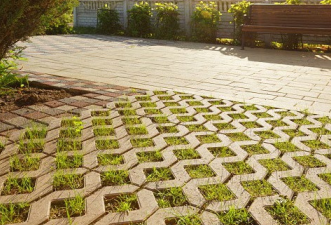 |
| Figure 26: Improve runoff quality onsite using best practices, such as draining to vegetation, using permeable paving and/or collect and drain runoff. |
19. Redirect downspouts, where feasible, to gardens, grassy areas, and rain barrels.