

Kelowna advances pedestrian safety with data-driven strategy

Topics
Oct 23, 2025
Traffic signal updates and road markings are just a few of the ways intersections are becoming safer for pedestrians and cyclists.
Kelowna City Council received a comprehensive update on transportation safety recently, highlighting a renewed focus on pedestrian protection and infrastructure improvements.
The report, presented by the Integrated Transportation Department on Oct. 6, outlines current trends in transportation-related incidents and introduces a roadmap for future safety initiatives.
Giving walkers a head start
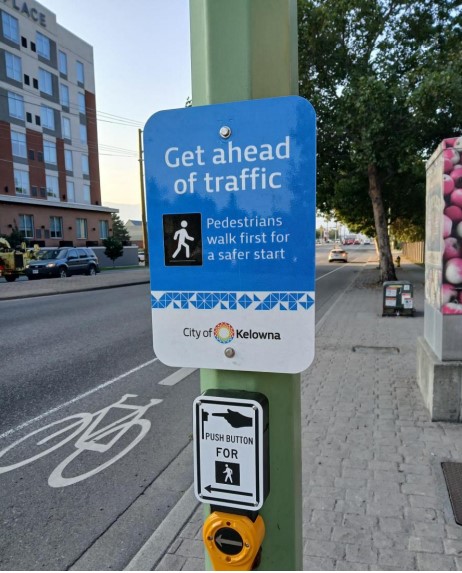
One of the more noticeable changes for drivers is the Leading Pedestrian Intervals. They are an internationally proven safety measure that activates the pedestrian ‘walk’ signal between 5 seconds before the signal turns green for vehicles going in the same direction.
This lets people crossing the road to establish their right of way and be more visible to left- and right-turning drivers. Some studies demonstrate up to a 59 per cent reduction in vehicle-pedestrian collisions at signalized intersections.
The update follows a Council directive from August 2025 calling for a detailed review of motor vehicle and pedestrian incidents, as well as an overview of capital projects aimed at improving traffic and pedestrian safety. The report also includes plans for enhanced enforcement through collaboration with the RCMP.
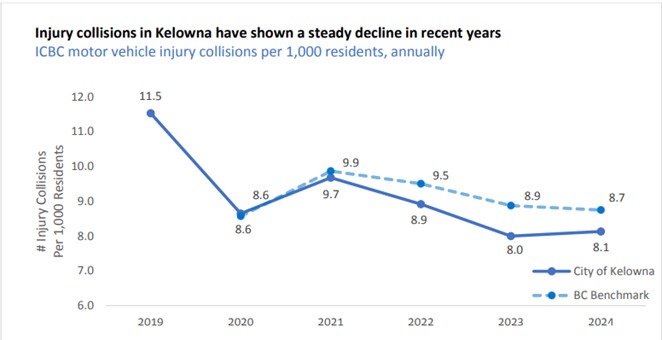
The City’s approach is grounded in data-informed planning and proactive investment. Central to this strategy is the forthcoming Safe Mobility Action Plan (SMAP), which builds on the 2040 Transportation Master Plan and aligns with provincial and national road safety strategies. The SMAP is expected to be presented to Council in the coming months.
“The SMAP demonstrates the City’s recognition that traffic safety is a top priority for Kelowna,” the report notes. “It provides clear direction and actions to reduce the frequency and severity of collisions.”
One of the key principles of the SMAP is the adoption of a Vision Zero framework — a globally recognized strategy aimed at eliminating transportation-related fatalities and serious injuries. The plan places particular emphasis on protecting vulnerable road users, including pedestrians, cyclists, and individuals using mobility aids.
Infrastructure upgrades you'll notice
According to the report, Kelowna has already begun implementing several infrastructure upgrades designed to improve pedestrian safety. These include enhanced crosswalks, improved lighting, and traffic calming measures in high-risk areas. The City is also exploring the use of automated speed enforcement and other technologies to support safer streets.
Another innovation is the installation of signs with a blue light that lets cyclists know their presence in the intersection is noted, and they will be given some lead time to get through the intersection before the cars do.
“Advancing transportation safety requires a comprehensive approach,” said Nathan Carswell, Strategic Transportation Planning Manager with the Integrated Transportation Department. “We’re looking at engineering, education, and enforcement as interconnected tools to make our roads safer for everyone.”
Enforcement and education go hand in hand
The report also highlights the importance of interdepartmental coordination and community engagement. The City is working closely with law enforcement, public health officials, and advocacy groups to ensure that safety initiatives reflect the needs and experiences of all road users.
As part of the coordinated response, the RCMP has been asked to provide an update on traffic enforcement and road safety. This will include data on speeding, impaired driving, and other infractions that contribute to pedestrian risk.
Council members expressed support for the direction outlined in the report, emphasizing the need for continued investment and public awareness.
“We know that infrastructure alone isn’t enough,” said one councillor during the meeting. “Education and enforcement are key to changing behavior and making sure our streets are safe.”
The City plans to monitor progress through regular reporting and performance metrics. These will track reductions in collisions, injuries, and fatalities, as well as improvements in public perception of safety.
While the report acknowledges that challenges remain—such as funding constraints and the complexity of urban traffic systems — it underscores Kelowna’s commitment to creating a safer, more accessible transportation network.
“By taking a proactive and collaborative approach, we can make meaningful progress toward our goal of zero serious injuries and fatalities,” the report concludes.
Residents are encouraged to participate in upcoming consultations related to the SMAP and to share feedback on transportation safety concerns through Get Involved, the City’s engagement platform.
Also, for more pedestrian and cyclist safety tips, visit:
https://www.icbc.com/road-safety/sharing/pedestrian-safety
https://rcmp.ca/en/bc/safety-tips/road-safety/pedestrian-safety