
When fire shut down the Glenmore Landfill
Topics
Jan 9, 2026
In August 2023, the McDougall Creek wildfire erupted in West Kelowna, fueled by extreme drought, soaring temperatures, and powerful winds. As conditions worsened, the fire leapt across Okanagan Lake, threatening Kelowna’s neighbourhoods and infrastructure.
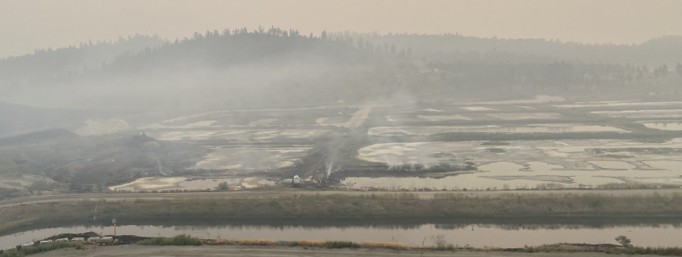
One of the areas at risk was the Glenmore Landfill, where drifting embers had the potential to spark a new fire. City staff were alerted and ready to mobilize the resources needed to react if necessary.
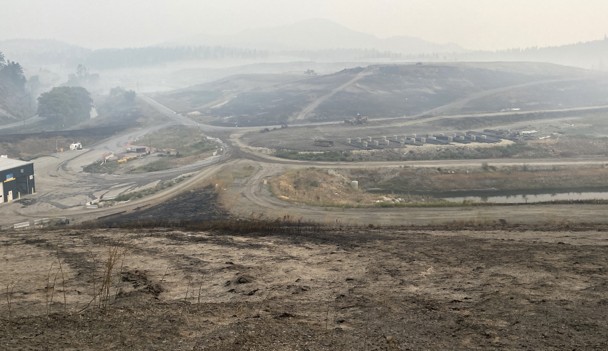
“The Glenmore Landfill is a high-risk location because landfill fires can burn deep underground, produce toxic smoke, have hidden hotspots, and require specialized equipment and expertise to extinguish,” explains Scott Hoekstra, landfill and compost operations manager.
When fire did break out at the landfill from the wind-blown embers, the whole team moved quickly to respond.
The Kelowna Fire Department and BC Wildfire Service led suppression efforts, deploying heavy machinery, water tenders, and thermal imaging to put out hotspots and protect vital infrastructure. Their coordinated response safeguarded the landfill’s gas collection systems, reduced environmental risks, and stabilized the site for recovery operations.
“Landfill staff played a key support role, working alongside fire crews to provide site knowledge and operate heavy equipment,” adds Hoekstra. “Using excavators, thermal cameras, and water trucks, staff helped expose and cool burning waste, protecting nearby neighbourhoods, City infrastructure, and the environment.”
Despite these efforts, the site was closed for a week to extinguish the fires and operated at partial capacity the following week while restorative work was complete.
The fire caused critical infrastructure damage, and left the landfill gas system collection system operating at only 60 per cent capacity. This was a significant setback because the Glenmore Landfill is the backbone of waste management for the Central Okanagan – including Peachland, West Kelowna, Kelowna and Lake Country.
Every year, the landfill handles garbage from 250,000 residents and businesses. It also operates a gas collection system that captures landfill gas, and converts it into renewable natural gas through a partnership with FortisBC, enough to heat up to 700 homes.
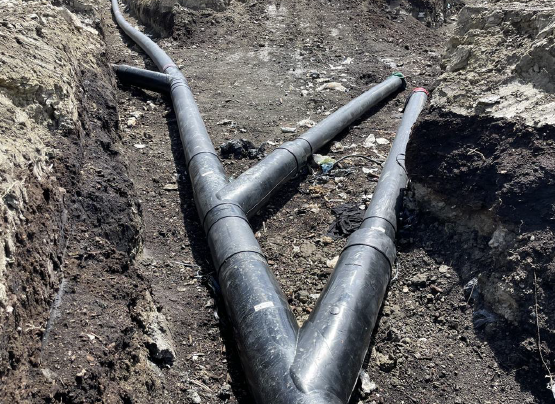
“About one-third of that gas collection system was destroyed, and heavy debris further disrupted site operations,” says Hoekstra.
Larry Watkinson, deputy fire chief operations and advanced planning, says, “landfill fires are unique and can be challenging to contain.”
“Burning waste piles are unstable. Firefighters must work closely with heavy-equipment operators to safely dig out and separate burning material,” he explains. “The 2023 wildfires around Kelowna placed additional strain on emergency resources and highlighted the vulnerability of the Glenmore Landfill. Smoke, heat, and ember exposure increased the risk of ignition, and portions of landfill infrastructure were impacted. The events reinforced that landfill fire suppression must be rapid, well-coordinated, and properly resourced.”
Staff and contractors worked around the clock for weeks to restore gas systems, remove hazardous debris, and stabilize burned areas. Additional upgrades, including new liners and leachate systems, were scheduled into 2024 to strengthen resilience against future fires.
Repairs were assessed at $1.4 million, which included $900,000 for new gas wells, pipes, and headers, and $500,000 for relocating and securing burnt waste. The City received Provincial Disaster Financial Funding to offset these costs.
Flames aren’t always a bad thing
Watkinson adds that while wildfires at the landfill are a significant threat, seeing flames at the landfill isn’t necessarily a cause for concern. Controlled burns are used in the setback areas of the landfill as they help reduce fuel loads and wildfire risk. Staff follow strict safety protocols, using heavy equipment and water trucks to keep operations safe and efficient.
The City of Kelowna manages the landfill in a way that recognizes its importance in the daily lives of Central Okanagan residences. Downtime must be kept to a minimum, but sometimes there is no avoiding a shutdown – and this experience showed how the operation can adapt to meet whatever is thrown at it.
When the McDougall Creek wildfire was eventually contained in September 2023, it had scorched nearly 14,000 hectares, blanketed the valley in thick smoke, and placed enormous strain on emergency resources. More than 500 firefighters from across B.C. and beyond worked grueling 12- to 16-hour shifts in hazardous conditions to battle the flames, on both sides of Okanagan Lake