

2040 Official Community Plan - Form & Character
Low & Mid-Rise Residential Mixed Use

4.0 Low & mid-rise residential & mixed use
Overview |
|
General Characteristics |
|
In order to achieve the design goals of the City, all low and mid-rise residential and mixed use projects must:
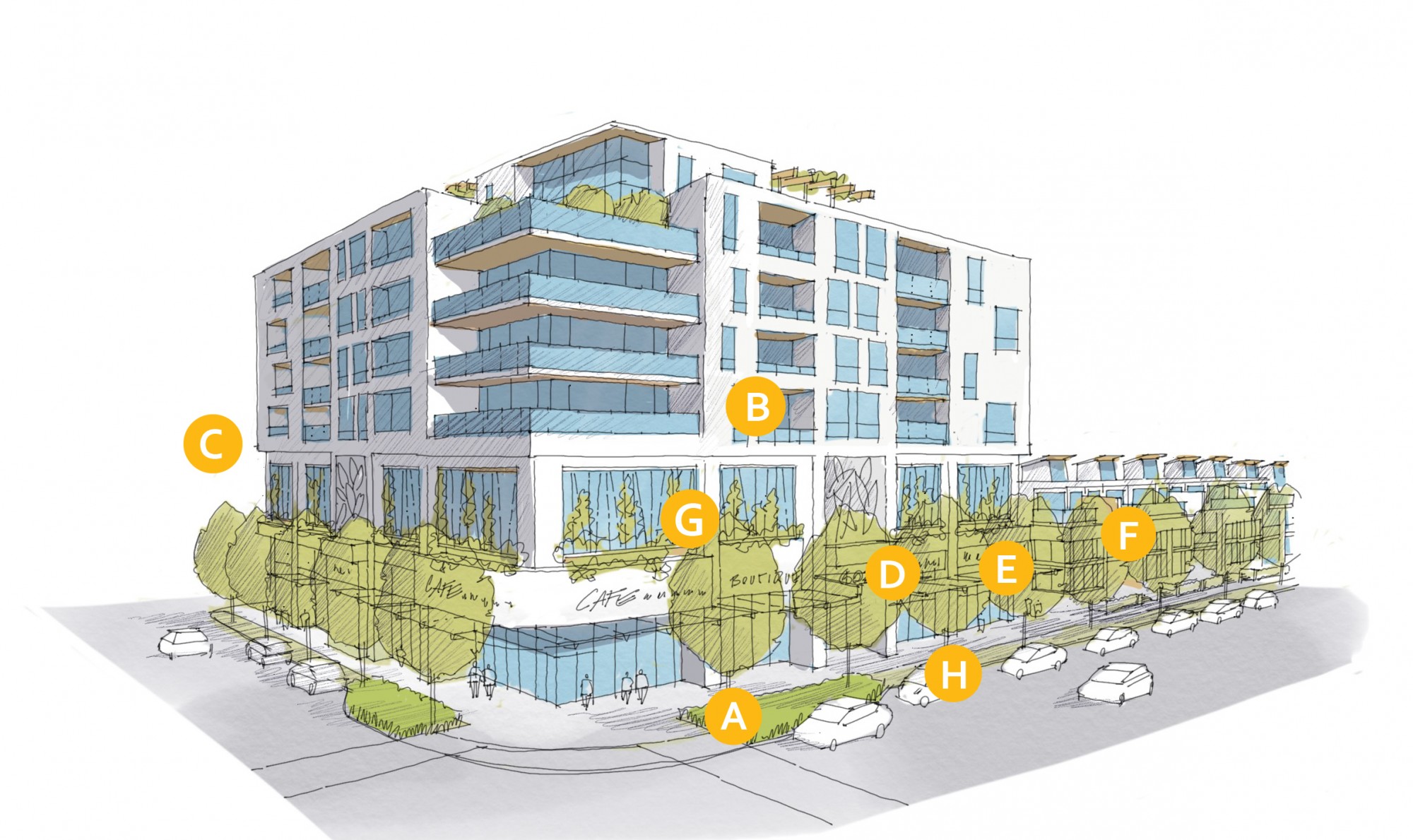
| A | 4.1.0 a – Provide attractive and active human-scale amenities oriented towards public spaces at grade such as a frequent entries, weather protection, and outdoor seating areas (see 4.1.1 and 4.1.5). |
| B | 4.1.0 b – Break up building mass by providing simple vertical and horizontal articulation of facades; e.g., step-backs, insets, projections, color and texture (see 4.1.6). |
| C | 4.1.0 c – Ensure buildings have a front-to-back orientation to streets and open spaces with back-of-house uses located to the rear of buildings to minimize impacts on public open spaces (see 4.1.3). |
| D | 4.1.0 d – Orient entries, windows, patios and balconies to face the fronting street. Ensure primary building entries are architecturally emphasized and directly accessible from the fronting public sidewalk (see 4.1.1). |
| E | 4.1.0 e – Maximize ‘eyes on the street’ by avoiding blank walls and providing direct lines of sight from windows and balconies to the sidewalk and adjacent public spaces (see 4.1.1 and 4.1.5). |
| F | 4.1.0 f – Provide access to underground or above ground on-site parking from secondary streets or lanes (see 4.1.4). |
| G | 4.1.0 g – When structured above grade parking is required due to the high water table, use store fronts or screening to mitigate visual impacts (see 4.1.4). |
| H | 4.1.0 h – Integrate semi-private open space with the surrounding streetscape (see 4.1.5). |
Commercial & Mixed Use Building
a. Ensure buildings have a continuous active and transparent retail frontage at grade to provide a visual connection between the public and private realm. (See Figure 11).
b. Site buildings using a common ‘build to’ line at or near the front property line so that a continuous street frontage is maintained. (See Figure 12). Some variation (1-3m maximum) can be accommodated in ground level set backs to support pedestrian and retail activity by, for example, incorporating a recessed entryway, small entry plaza, or sidewalk cafe.
c. Incorporate frequent entrances (every 15 m maximum) into commercial street frontages to create punctuation and rhythm along the street, visual interest, and support pedestrian activity (See Figure 11).
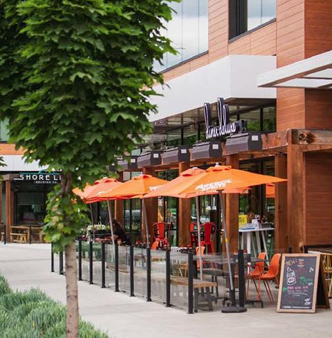 |
| Figure 11: Photograph showing an active retail frontage and visual connection between the public and private realm |
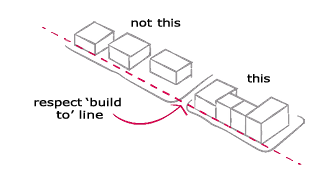 |
| Figure 12: Site buildings with commercial frontages continuously using a common 'build to' line |
Residential and Mixed Use Buildings
d. Incorporate individual entrances to ground floor units accessible from the fronting street or public open spaces. Set back residential buildings on the ground floor approximately 3 m from the property line to create a semi-private entry or transition zone to individual units and to allow for a front entryway or raised patio (See Figure 13).
- A maximum 1.2m height (e.g. 5-6 steps) is desired for front entryways; and
- Exceptions can be made in cases where the water table requires this to be higher. In these cases, provide a larger patio and screen parking with ramps, stairs and landscaping.
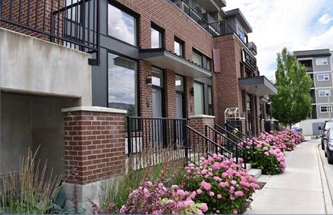 | ||
| Figure 13: Photograph of a residential building with semi-private transition area |
a. Residential building facades should have a maximum length of 60 m.
b. Residential buildings should have a maximum width of 24 m.
c. Where stairways and elevators are located on a publicly visible facade, ensure that they are architecturally integrated into the design of the building.
d. Provide a transition between properties with higher densities and heights (e.g. adjacent to a Transit Supportive Corridor) and neighbouring properties by using strategies such as (See Figure 14):
- Enhanced landscaping along shared property lines;
- Additional setbacks from buildings to shared property lines;
- Orienting the building massing (e.g. stepback upper storeys) away from neighbouring properties and towards streets or other public open spaces;
- Insetting balconies adjacent to neighbouring properties; and/or
- Using clerestory and/or frosted windows to reduce overlook.
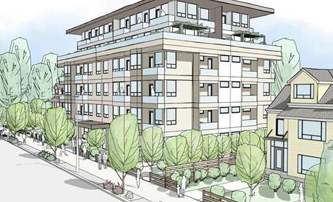 |
| Figure 14: Illustration of a transition between neighbouring properties showing enhanced landscaping, additional setbacks, orienting massing towards street, in-setting balcony, and clerestory windows |
Seven to twelve storey buildings
e. Buildings between seven and twelve storeys should:
- Incorporate a 2-3 storey podium at the base of the building (see 4.1.1 a to c for commercial interface guidelines and 4.1.1 f for residential interface guidelines);
- Incorporate a minimum 3m stepback in upper storeys, and more generous upper storey terraces facing south and west; and,
- Have a minimum 30m building separation between primary building facades.
f. To support and promote the use of mass timber construction, expectations to setback and podium design guidelines will be considered to accommodate unique design challenges and technical requirements.
a. On sloping sites, floor levels should step to follow natural grade and avoid the creation of blank walls
Connectivity
b. Break up large buildings with mid-block connections which should be publicly accessible wherever possible (See Figure 15).
c. Ground floors adjacent to mid-block connections should have active frontages with entrances and windows facing the mid-block connection, seating, and landscaping (See Figure 16).
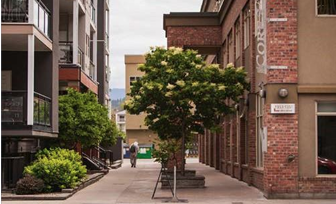 |
| Figure 15: Photograph of a mid-block connection going through a long development site |
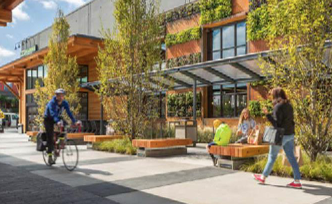 |
| Figure 16: Example of a mid-block connection with seating, landscaping, and active frontages |
a. Above-grade structure parking should only be provided in instances where the site or high-water table does not allow for other parking forms and should be designed to screen the parking structure from public view:
- On portions of the building that front a retail or main street, line the above ground parking with active retail frontage;
- On portions of the building that front onto non-retail streets, line the above ground parking with an active residential frontage, such as ground-oriented townhouse units or amenity spaces;
- When active frontages are not able to be accommodated, screen parking structures by using architectural or landscaped screening elements;
- On corner sites, screen the parking structure from the public view on both fronting streets using the appropriate strategy listed above; and
- When above-grade parking structures will be temporarily visible until future redevelopment of adjacent lots, screen the parking structures by incorporating simple details such as patterns, textures, colours, or materials other than exposed concrete.
a. Locate semi-private open spaces to maximize sunlight penetration, minimize noise disruptions, and minimize ‘overlook’ from adjacent units.
Outdoor Amenity Areas
b. Design plazas and urban parks to:
- Contain ‘three edges’ (e.g., building frontage on three sides) where possible and be sized to accommodate a variety of activities;
- Be animated with active uses at the ground level; and,
- Be located in areas with access to sunlight and shading.
c. Design internal courtyards to:
- Provide amenities such as play areas, barbecues, and outdoor seating where appropriate;
- Provide a balance of hardscape and softscape areas to meet the specific needs of surrounding residents and/or users; and
- Incorporate shading to make the space comfortable during the summer.
Rooftop Amenity Spaces
d. Design shared rooftop amenity spaces to include features such as rooftop gardens, planter boxes, play areas, seating, shade structures and other social and recreational features which are accessible to residents and to ensure a balance of amenity and privacy by (see Figure 17):
- Limiting sight lines from overlooking residential units to outdoor amenity space areas through the use of pergolas or covered areas where privacy is desired; and
- Controlling sight lines from the outdoor amenity space into adjacent or nearby residential units by using fencing, landscaping, architectural screening, or setting back the usable area from the building edge.
e. Activate usable space on flat roofs through one or more of the following considerations:
- Reduce the heat island effect by including plants or designing a green roof, with appropriate soil depths, suitable species, and necessary irrigation and drainage;
- Install solar panels;
- Provide shared rooftop amenity spaces; and/or
- Reduce heat absorption with light coloured surfaces.
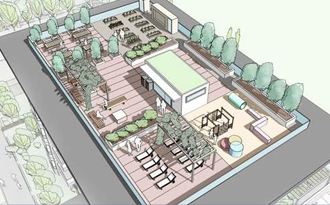 |
| Figure 17: Illustration of a shared rooftop amenity |
a. Break up the building mass by incorporating elements that define a building’s base, middle and top.
b. Avoid repetition and encourage variation in the design of buildings located within close proximity to each other. Strategies may include (See Figure 18):
- Varying building forms and heights;
- Utilizing different roof heights and shapes (e.g. flat vs peaked);
- Varying location of building massing (e.g. setbacks and stepbacks);
- Use of different colours and materials; and
- Varying landscape treatments.
c. Incorporate distinct architectural treatments for corner sites and highly visible buildings using strategies such as:
- Varying the roofline;
- Articulating the facade;
- Adding pedestrian space, urban plazas, street furnishings, patios, or public art; and
- Increasing the number and size of windows and adding awnings and canopies.
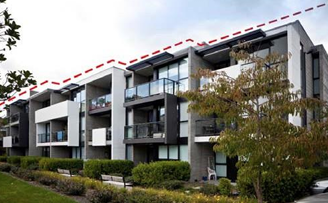 |
| Figure 18: A residential building's roof form is stepped to break up the overall form |
Weather protection
d. Provide weather protection (e.g. awnings, canopies, overhangs, etc.) along all commercial streets and plazas, with particular attention to the following locations:
- Primary building entrances;
- Adjacent to bus zones and street corners where people wait for traffic lights;
- Over store fronts and display windows; and
- Any other areas where significant waiting or browsing by people occurs.
e. Architecturally-integrate awnings, canopies, and overhangs to the building and incorporate architectural design features of buildings from which they are supported. Place and locate awnings and canopies to reflect the building's architecture and fenestration pattern.
f. Place awnings and canopies to balance weather protection, daylight penetration, and shading. Avoid continuous opaque canopies that run the full length of facades.
Signage
g. Provide attractive signage on commercial buildings that identifies uses and shops clearly but which is scaled to the pedestrian rather than the motorist. Some exceptions can be made for buildings located on highways and/or major arterials in alignment with the City’s Sign Bylaw.
h. Avoid the following types of signage:
- Internally lit plastic box signs;
- Pylon (standalone) signs; and
- Rooftop signs.