

Water Security Plan

About the plan
Vision
Water management in Kelowna is approached from a holistic, “one water” lens that guides decision-making and long-term planning, while reflecting the importance of water for our communities and our environment.
Guiding Principles
- All residents and water users in the City have a safe, affordable, resilient and sustainable supply of high-quality drinking water and a reliable supply of water for agriculture.
- Protect Okanagan Lake, our human health, and our environment through efficient collection and effective treatment of wastewater.
- Stormwater is effectively managed without negatively impacting riparian areas, infrastructure, property, or Okanagan Lake.
- Our community is resilient and resistant to lake and creek flooding.
- Okanagan Lake and upland watersheds remain a source of high-quality water
- Natural Systems are accounted, protected, restored, and enhanced to improve our environmental resiliency.
- Assure that the quality and quantity of water is available to support a healthy aquatic ecosystem.
- syilx knowledge, practice and permitting is effectively incorporated into water decision processes.
- The City works in partnership with other water providers and government agencies to ensure water security.
The six key sectors
The Water Security Plan emphasizes the need to coordinate City operations and long-term actions by identifying six key “sectors” of water responsibility. The holistic nature of water is completed by three foundational elements that promote good governance, partnerships and embedding syilx Knowledge. There are 29 actions in the plan supporting each of these sectors.
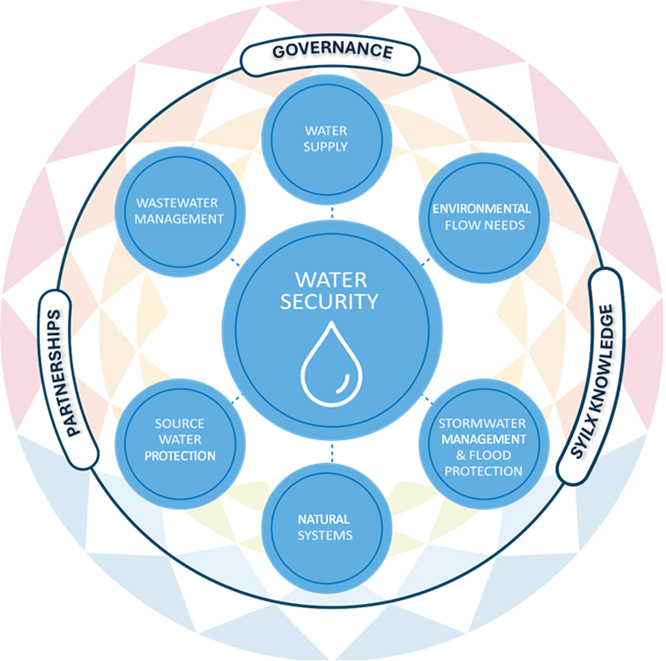
Water is critical for both life and our economy. Supplying safe and reliable water is one of the most important roles for a local government. In Kelowna, we live in a semi-arid environment where the water is in limited in supply. We share our water sources with other users, wildlife and the natural environment.
Short-term
- Conserve water. Update water demand criteria in Bylaw 7900 updating infill zoning and new light industrial requirements.
- Review and upgrade water infrastructure in urban core areas to assure that water supply is adequate to meet firefighting requirements to facilitate densification.
- Increase our measurement of water use and focus on evidence-based decision making by aligning water consumption data with irrigation use.
- Advise government and the agricultural community of the commitment required to renew and replace aging supply and delivery infrastructure.
Medium-term
- Develop funding strategies that assure that non-potable water is supplied to the agricultural community.
- Assure resiliency and water quality supply risk mitigation through interconnectivity of sources.
- Evaluate transmission connectivity between McKinley intake and Dilworth Reservoir.
- Install multiple connections between GEID and City system to interconnect the networks.
Long-term
- Protect public health by developing concept plans and ensuring land is available for addition of filtration facilities at all potable water supply locations.
Wastewater management is crucial for the health and safety of our community. Since we source some of our domestic water supply from Okanagan Lake, the lake water needs to be clean and reliable. Wastewater treatment is a critical process at the City of Kelowna because of the potential health and safety consequences for our drinking water.
Short-term
- Develop and implement improvements to wastewater treatment facility to address challenges related to increasing concentration of influent.
Medium-term
- Work with Interior Health to add tracking of emerging contaminants of concern that are under the City’s scope of responsibility.
Long-term
- Plan for an alternate treatment plant site to be included in the development of new processes and capacity improvements.
- Transition on-site septic systems to community sewer in urbanized areas. Complete the transition program by 2040.
The City needs to incorporate EFNs as part of its responsibilities. While directly impacting various aspects of water practice, environmental and riparian specialists must be engaged with various sectors of the City. EFN’s are critical elements in the water security plan as they support the survival of fish, wildlife and other natural systems. They are also a critical requirement in all new water license from creeks and lakes.
Short-term
- Incorporate critical flow needs into the City’s drought management and water shortage plans.
- Investigate modifications to storage infrastructure to optimize release to minimize losses and ensure environmental flow needs are met.
Medium-term
- Work with the Province and partners to plan reservoir storage in the upper watersheds and improve management of critical flow releases to our creeks, reducing impacts to allotments for the agricultural industry
How we protect where the water we use comes from, primarily Okanagan Lake and upland watersheds. Natural Systems: lakes, creeks, wetlands, forests, soil and more.
Short-term
- Develop policy for recreational development that minimizes impacts from watercraft, effluent discharges and other items impacting source water Protection Zones identified in the OCP.
Medium-term
- Participate in development of a new Watershed Sustainability Plan for Mission Creek.
- Provide resources to manage issues within the Source Water Protection Portfolio. This staff can also participate at the Okanagan Basin Water Board.
- Provide resources to develop long term data analysis on water quality within Okanagan and upper watershed.
As Kelowna is in a semi-arid valley where it is hotter and rains less frequently than other parts of Canada, our stormwater management needs are different than the larger cities that have formal plans. We need to enable staff and resources to improve best management practices to prevent excessive pollution and nutrient levels into Okanagan Lake, our primary water source.
Short-term
- Establish guidelines for maintenance and operation of naturalized storm ponds and constructed areas.
- Update best management practices for the operation, maintenance, and renewal of storm infrastructure to protect the public, infrastructure, and the environment.
- Consider implementing a Stormwater Utility to incentivize effective stormwater quality and quantity management from private property.
Medium-term
- Improve stormwater quality by conducting research on public stormwater ponds for nutrient management and habitat development to develop best management practices.
- Complete stormwater basin plans that include overland flow routes, safe discharge to natural systems, and account for future development.
- Update engineered solutions for urban development to reduce pollutants and fine sediment at the source.
Natural systems fill many key functions in water security, including preventing flooding, enabling stormwater to runoff safely, supporting healthy habitats for fish and wildlife, controlling temperatures, and naturally filtering and treating water. In many cases, the natural systems serve these needs more effectively than any artificial or engineered solutions. We need to better engage staff and resources to protect the existing natural systems that support water security in the city. Elements otherwise become difficult and costly to replace – and, sometimes, impossible to fully restore.
Short-term
- Create a Habitat Compensation Bank for all environmental permitting requirements
Medium-term
- Complete a natural asset inventory by adding water responsibility considerations and incorporating the inventory into the City’s Asset Management Program.
- Investigate possible zoning regulations to support the identification, protection and/or restoration of natural system protection areas.
Long-term
- Restore creek riparian areas and reduce negative human impacts.
Why does Kelowna need a Water Security Plan?
Kelowna doesn’t own water. Instead we have limited rights to access water legislated through the Province. The City relies heavily on Okanagan Lake for both its supply and discharge. As we share access to the lake and creeks with other communities and wildlife, we all have a responsibility towards its stewardship and management. We must protect our lake and watershed to ensure future generations can continue to prosper. All residents, visitors and businesses in our community are responsible, directly or indirectly, for the quantity and quality of water that we use and return to the environment.
How will this Water Security Plan improve water management?
The Water Security Plan will establish a foundation for more collaborative stewardship of water in and around Kelowna by:
- Developing an understanding of the City’s roles and responsibilities towards water, with an understanding of the interests of other partners within the Okanagan Lake basin.
- Identifying City sectors that all share the common goals of resiliency and responsibility towards water and Okanagan Lake.
- Assuring our organizational policies, budgets and resource allocation decisions are aligned.
- Identifying sustainable funding sources and models to support achievable outcomes.
- Addressing the impacts of growth and climate change on water security.
- Underlining the importance of transparency, consultation and raising awareness.
- Proposing new best management practices to ensure efficient service delivery