

Wildfires & fire emergencies
Wildfires & Fire Emergencies
Report fires, check emergency updates, and see how we're learning from past wildfires to make our community safer.
REPORT NOW
Active fire in city limits: Call 911
Smoke or fire in a park:
Call 1-800-663-5555 or *5555 (cell)
Non-emergency hazards: Report Online
Check for emergency updates
Visit the Central Okanagan Emergency Management website for accurate information on emergencies, evacuations, and maps. Be sure to sign up for email updates.
Emergency Updates
Be aware of planned burns
The Kelowna Fire Department uses planned, controlled fires to reduce wildfire risk and restore natural areas. Check for planned burns happening near you.
Planned Burns
Fire safety starts at home
Be prepared, be FireSmart. Create a family evacuation plan, protect your home inside and out, and find helpful tips to keep your family and loved ones safe.
Get Prepared
Lessons from past wildfires
The Central Okanagan faces a high wildfire risk each year due to its dry summers, forested landscape, and history of major fire events. From the 2003 wildfire to more recent seasons, the City of Kelowna and its partners continue to strengthen prevention, preparedness, and community resilience to reduce the impact of the next wildfire.
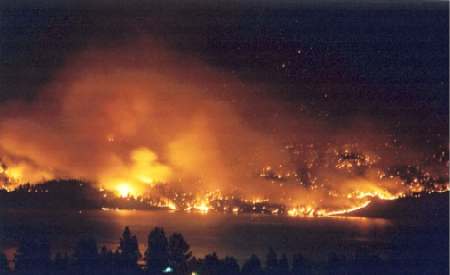
The Okanagan Mountain Park fire of August and September 2003 consumed over 25,000 hectares of forest and park land south and east of the city, forcing the evacuation of more than 27,000 people and destroying 239 homes on the southern edges of the city.
The one-in-a-hundred-year inferno began with a lightning strike on Aug. 16. The firestorm challenged personnel from over 60 fire departments across B.C., over 1,000 forestry fire fighters, contractors and loggers, as well as 1,400 members of the Canadian Armed Forces.
The Regional District of the Central Okanagan’s Emergency Response Plan was put into action and the emergency operations centre (EOC) at the main fire hall on Enterprise Way worked smoothly and efficiently. Inter-agency cooperation was paramount at both the EOC and at incident command.
Recovery effort
Our Fire Recovery Team was formed in September 2003 to spearhead community recovery efforts in the wake of the fire’s devastation. The City established a recovery centre office on Bernard Avenue in space donated by RBC Royal Bank, and recovery centre staff helped process all social service requests arising from the fire.
We also established the Kelowna and Area Okanagan Fire Recovery Society to coordinate the recovery effort; working in concert with other agencies and groups, society volunteers helped rebuild lives and the community.
Trust fund
The Recovery Society was also charged with administering the Kelowna and Area Okanagan Fire Recovery Trust Fund, created by us to assist in the rebuilding effort. Through the generosity of our community and others across the country, the Society was able to distribute $1,402,000 to those impacted by the fire. The Society’s final report to Council outlines the distribution of funds. The Society wound up its operations in April 2004, and the recovery centre is now closed.
In August 2023, the McDougall Creek wildfire swept through West Kelowna, Westbank First Nation lands, and parts of Kelowna in what became one of the most destructive fire events in the region’s history. The fast‑moving fire ultimately burned nearly 14,000 hectares and forced more than 35,000 residents from their homes across the Central Okanagan. Over 300 structures were lost, including entire neighbourhoods in West Kelowna and the historic Lake Okanagan Resort.
The wildfire began on August 15 under severe drought conditions. Within days, strong winds drove the fire down the hillsides and across Okanagan Lake, igniting spot fires in Kelowna and threatening multiple communities simultaneously. Firefighters from across British Columbia, BC Wildfire Service crews, contractors, and local fire departments worked around the clock to protect homes and critical infrastructure. Their efforts were supported by a province‑wide mobilization of emergency personnel, equipment, and air support.
The Central Okanagan Emergency Operations Centre (EOC) was activated at a regional level, coordinating evacuations, public information, and inter‑agency response. The scale and speed of the fire required close cooperation between municipal fire departments, BC Wildfire Service, RCMP, Emergency Support Services, and Westbank First Nation. Despite the intensity of the firestorm, there were no reported fatalities.
Recovery Effort
In the weeks following the fire, recovery planning began across the region. Damage assessments were completed for affected neighbourhoods, and support services were provided to displaced residents through Emergency Support Services and community partners. Local governments worked with provincial agencies to restore utilities, assess slope stability, and begin long‑term recovery planning.
The recovery process included debris removal, environmental assessments, and support for residents navigating insurance claims and rebuilding requirements. Community organizations, volunteers, and local businesses played a significant role in helping families return home and begin the process of rebuilding their lives.
A Community Moving Forward
The 2023 wildfires left a lasting impact on the Central Okanagan, underscoring the growing risks posed by drought, extreme weather, and the expanding wildland–urban interface. The event also highlighted the strength and resilience of the community—neighbours supporting one another, emergency personnel working under extraordinary pressure, and residents showing determination in the face of loss.
The fires also reinforced the importance of long‑term wildfire preparedness. The Community Wildfire Resiliency Plan (CWRP) Program, originally created in British Columbia in response to the devastating 2003 Kelowna wildfire, continues to guide this work. As part of the province’s Strategic Wildfire Prevention Initiative, managed and funded through the Union of British Columbia Municipalities, CWRPs provide strategic recommendations to improve public safety and reduce the risk of wildfire damage to homes, neighbourhoods, and critical infrastructure. The lessons learned in 2023 have further strengthened the region’s commitment to these planning efforts.
Wildfire recovery and resilience planning remain central to the region’s approach to emergency management. From FireSmart initiatives to community education, fuel mitigation projects, and updated emergency response strategies, the Central Okanagan continues to build on the experience of 2023, working toward a safer, more prepared future for all residents.